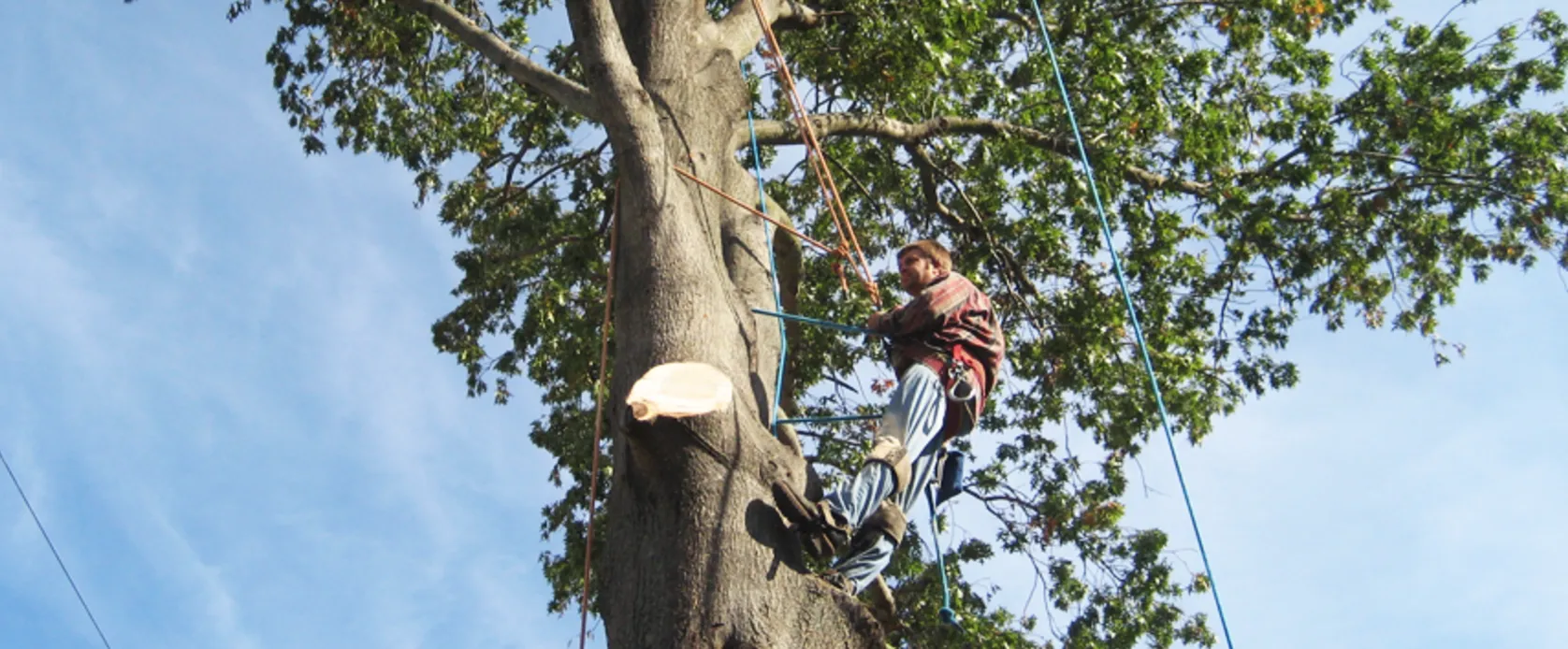
Tree Trimming & Pruning in Bedford
Expert pruning for Bedford and Lawrence County — where shallow limestone bedrock demands a different approach to tree care.
$20 OFF Your Service
Submit the form to claim your discount. Mention this offer when we call to confirm your estimate. Valid for all Bedford properties.
The Fastest Way to Get Your Quote
Submit the form and we'll dispatch an estimator to your Bedford property — that's our promise.
It's easier for everyone. We might be up in your neighbor's tree. The form gets us your info so we can schedule your estimate right away.
Prefer to call? We're here at (812) 432-2013
Get Your Quote in 24 Hours
Fill this out and we'll send an estimator to your Bedford property.
How Bedford's Limestone Geology Shapes Tree Pruning Needs
Bedford is the Limestone Capital of the World, and that geology does not just define the local economy — it directly shapes how trees grow and how they need to be pruned on Lawrence County properties. The Indiana limestone bedrock underlying Bedford is often just 12 to 24 inches below the soil surface, and in some areas it is exposed at grade. Trees growing in this shallow soil cannot develop the deep taproots and extensive lateral root systems they would produce in deeper soils. Instead, roots spread outward along the bedrock surface, creating wide but shallow root plates.
This has direct consequences for pruning strategy. A tree with a shallow root system is more vulnerable to windthrow — being pushed over during high winds — because it lacks the deep anchoring that resists lateral force. Pruning reduces wind load on the canopy, which in turn reduces the lateral force transferred to those shallow roots. For Bedford properties with large canopy trees growing on shallow limestone, regular crown thinning is not optional maintenance. It is risk management.
The shallow bedrock also affects species selection and growth patterns. Red oak, tulip poplar, and sycamore — all common in Bedford — naturally produce deep roots when conditions allow. Constrained by limestone, these species develop root plates that push sidewalks, buckle driveways, and compromise foundations. Pruning cannot solve a root conflict, but it can extend the functional life of a tree by keeping the canopy proportional to the root system's capacity. A tree that is allowed to grow an oversized canopy on an undersized root system is a tree waiting for the right storm to bring it down.
Sugar maple adapts better than most species to Bedford's shallow soils because it naturally produces a fibrous, spreading root system. But even sugar maples on limestone need attention. The limited soil volume available means these trees are more susceptible to drought stress during hot Indiana summers, and drought-stressed trees are more vulnerable to secondary pest attacks. Keeping the canopy properly thinned improves air circulation, reduces water demand, and helps the tree make the most of the limited soil resources available to it.
Caring for Bedford's Historic Downtown Canopy
Bedford's established neighborhoods along 16th Street, J Street, and Lincoln Avenue have some of the most impressive shade tree canopy in Lawrence County. Many of these trees were planted 50 to 80 years ago when the neighborhoods were built, and they are now mature specimens with canopy spreads of 40 to 60 feet or more. These trees define the character of these streets, provide significant cooling shade in summer, and add measurable value to every property they shelter.
But trees this old require proactive management. A 70-year-old red oak on Lincoln Avenue has had seven decades to accumulate deadwood, develop structural defects at branch unions, and grow branches that now interfere with rooflines, gutters, and utility lines. Ignoring these issues does not make them go away. It allows them to worsen until a storm converts a manageable pruning job into an emergency removal.
Crown raising is a frequent need on Bedford's historic street trees. Lower branches that were charming when the tree was 30 years old are now 10-inch-diameter limbs hanging 8 feet off the ground, blocking driveways, scraping delivery trucks, and forcing pedestrians off the sidewalk. Removing a branch that size requires a proper three-cut technique — an undercut to prevent bark tearing, a removal cut beyond the undercut, and a final cut at the branch collar — along with rigging to control the limb's descent in tight spaces between parked cars and overhead wires.
Crown thinning on these mature canopies is typically the highest-impact work we perform on Bedford's downtown streets. Opening the interior of the crown by removing crossing, rubbing, and inward-growing branches allows light and air to penetrate the canopy, which improves leaf health, reduces fungal pressure, and lets wind pass through rather than pushing against a solid wall of foliage. We thin conservatively — never more than 20 to 25 percent of live canopy per visit on mature trees — because excessive thinning triggers a stress response that produces dense water sprout growth, undoing the work entirely.
Deadwood in these aging canopies is a liability issue. A dead limb falling from 60 feet onto a parked car, a passing pedestrian, or a neighbor's fence creates an immediate problem and a potential legal exposure. Regular deadwood removal — every three to five years on mature oaks and maples — is the baseline standard of care for any property owner with large street trees in Bedford's historic core.
Species-Specific Trimming for Lawrence County Trees
Lawrence County's position between the White River valley and the Hoosier National Forest gives Bedford a diverse mix of tree species, each with its own pruning requirements.
Red oak is the most common large canopy tree in Bedford's residential areas. It grows into a tall, upright form with tighter branch angles than white oak, and those tight angles are where structural problems start. Red oaks in Bedford need early structural pruning to eliminate co-dominant stems before they become permanent defects. Once two competing leaders reach 6 inches in diameter or more, the included bark between them creates a structural weakness that cannot be corrected through pruning alone — at that point, supplemental cabling may be the only option short of removal. Catching this early, when the competing stem can simply be removed or subordinated, saves the tree and saves the property owner thousands of dollars in future intervention.
Sycamore is abundant along Bedford's creek corridors and in low-lying areas throughout Lawrence County. These fast-growing trees produce massive canopies and heavy horizontal branches that are prone to failure, particularly at the point where a large lateral branch meets the trunk. Sycamore wood is heavy and resistant to splitting, but the sheer weight of their branches can exceed the structural capacity of the attachment point over time. Crown reduction on large sycamore laterals — shortening them back to a strong secondary branch to reduce the lever arm and the weight — is a regular service we provide in Bedford.
Tulip poplar is common throughout Lawrence County and grows aggressively in the deeper soils found in drainage corridors and valleys. These trees produce tall, straight trunks with relatively narrow crowns, but their branch unions tend to be weak, with bark inclusion common at narrow angles. Structural pruning on young tulip poplars is the most cost-effective long-term investment, but even mature specimens benefit from crown cleaning that removes the dead, broken, and poorly attached branches that accumulate over time.
American beech grows in the shadier, more protected sites near Spring Mill State Park and the Hoosier National Forest boundary. Beech is a slow grower that rarely needs aggressive pruning, but it is sensitive to bark damage and root disturbance. We prune beech conservatively — deadwood and light structural corrections only — and we are careful to avoid trunk wounds that can serve as entry points for beech bark disease, which is present in Indiana.
Seasonal Pruning Timing for Bedford
Bedford sits in USDA climate zone 6a, the same as Bloomington, but its position slightly south and at lower elevation means spring arrives a week or two earlier and fall color peaks slightly later. These subtle differences matter for pruning schedules because optimal pruning windows are tied to phenology — the timing of biological events like bud break, leaf expansion, and dormancy onset — rather than to calendar dates.
Oak pruning in Bedford follows the same strict rule as everywhere in Indiana: no live cuts between April and July. Oak wilt, caused by the fungus Bretziella fagacearum, is vectored by sap beetles that are drawn to fresh pruning wounds during warm weather. The beetles carry fungal spores from infected trees to healthy ones through the wound, and the disease spreads through the root grafts that connect nearby oaks underground. One infected tree can kill an entire cluster through root connections. We schedule all elective oak pruning during December through March when beetle activity is essentially zero, or in late August through October when wound closure is fast enough to outpace beetle interest.
Sugar maple should be pruned in late winter dormancy, typically late February in Lawrence County. Pruning maples during sap flow — which begins in earnest in early to mid-March in Bedford — causes heavy sap bleeding from cuts. While sap bleeding does not directly harm the tree, it creates a mess, attracts insects, and can mask whether a cut is closing properly. Late-winter pruning avoids this entirely and gives the tree maximum healing time as growth begins in spring.
Fruit trees in Bedford backyards follow a separate schedule. Apple and pear trees benefit from dormant-season pruning in late February through early March, before bud swell. Stone fruits — cherry, plum, peach — are better pruned in early summer after bloom to minimize the risk of bacterial canker infection through fresh wounds. We handle fruit tree pruning as part of our residential service, applying the same attention to proper cut placement and canopy structure that we bring to large shade trees.
Deadwood and genuinely hazardous branches are the exception to all seasonal guidelines. A dead limb hanging over your driveway or a broken branch wedged in the canopy is a safety hazard that should be removed immediately, regardless of the time of year. Dead wood does not have active sap flow, so disease transmission through the pruning cut is not a concern.
Bedford's Trusted Tree Trimming Professionals
Bloomington Tree Service Pros serves Bedford and all of Lawrence County with ISA-certified arborists who follow ANSI A300 Part 1 pruning standards. We understand Bedford's unique limestone geology, the species growing in your neighborhoods, and the specific pruning demands created by shallow-rooted trees on bedrock.
We never top trees. Topping is the indiscriminate removal of large branches back to stubs, and it is the single most destructive thing you can do to a tree short of cutting it down. Topped trees produce dense clusters of weakly attached water sprouts that are far more likely to fail in a storm than the original branches. The large wounds left by topping cuts rarely close properly, allowing decay to penetrate deep into the trunk. We understand why some companies still offer topping — it is fast and cheap — but it creates problems that cost far more to fix than the original pruning would have cost to do correctly.
Our crews are fully insured with general liability and workers' compensation coverage on every Bedford job. We provide free on-site estimates that include a species-by-species assessment of your property's pruning needs. We tell you what needs work now, what can wait a season, and what is fine as-is. No upselling, no scare tactics.
If your Bedford property has trees that need professional attention — clearance pruning on a 16th Street canopy tree, deadwood removal over your Lincoln Avenue driveway, or structural training on young plantings — give us a call at (812) 432-2013. We are 30 minutes from Bedford and serve Lawrence County on a regular weekly schedule.
Our Tree Trimming & Pruning Service Includes
- Structural pruning for young trees to establish a dominant leader and balanced scaffold branches
- Crown thinning to improve light penetration and air circulation without over-pruning
- Crown raising to provide clearance over rooflines, driveways, and pedestrian areas
- Deadwood removal — all dead, dying, and broken branches removed from the canopy
- Oak wilt prevention scheduling: oak pruning timed outside the April–July high-risk window
- Species-specific timing for maples, sycamores, tulip poplars, and fruit trees
- Vista pruning to open sightlines while preserving tree health and canopy structure
- Fruit tree renewal pruning to maximize yield and manage size in home orchards
Other Tree Services in Bedford
Need Tree Trimming & Pruning in Bedford?
Fill out the form at the top of this page to claim your $20 discount and get a free on-site estimate from our ISA-certified team.