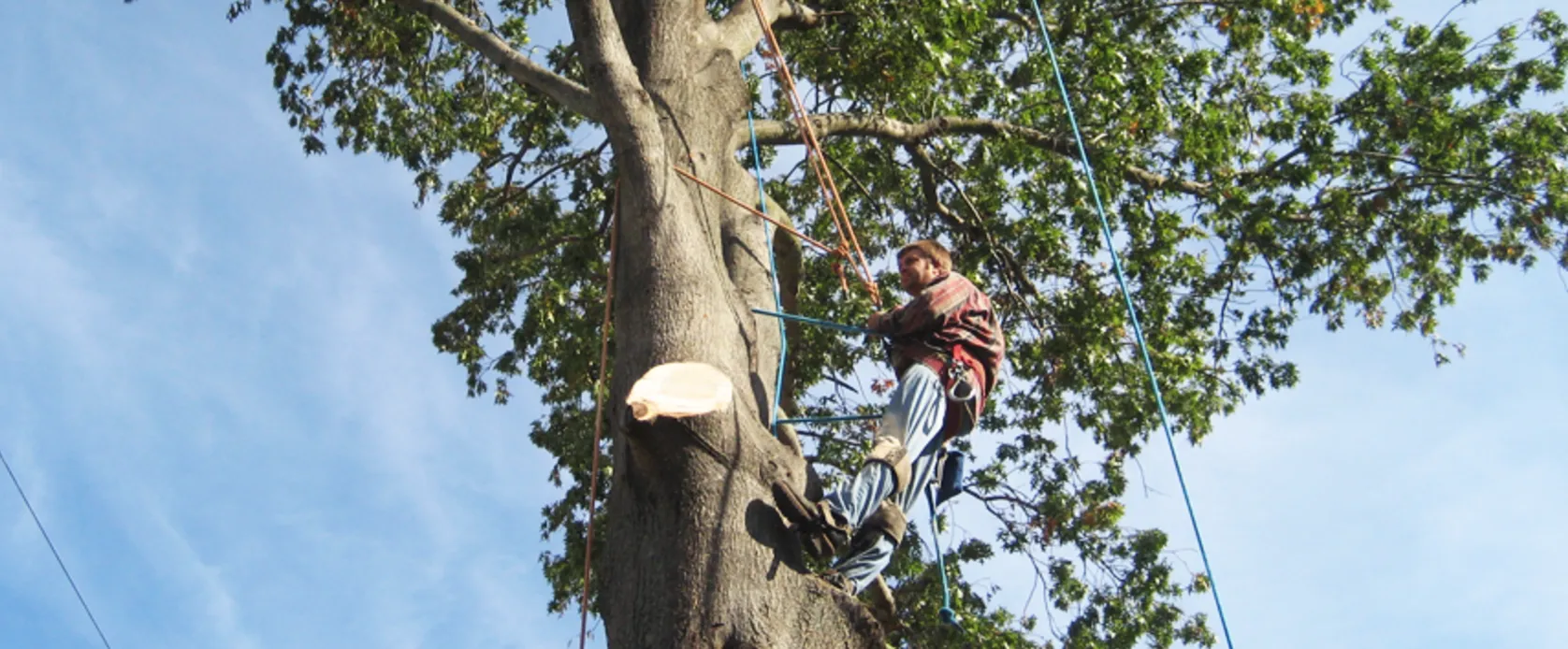
Tree Trimming & Pruning in Bloomington
Expert tree trimming Bloomington IN residents rely on to keep Indiana hardwoods healthy, structurally sound, and beautiful through every season. Our ISA-certified arborists follow ANSI A300 pruning standards for lasting results.
$20 OFF Your Service
Submit the form to claim your discount. Mention this offer when we call to confirm your estimate.
The Fastest Way to Get Your Quote
Submit the form and we'll dispatch an estimator to your property — that's our promise.
It's easier for everyone. We might be up in your neighbor's tree. The form gets us your info so we can schedule your estimate right away.
Prefer to call? We're here at (812) 432-2013
Get Your Quote in 24 Hours
Fill this out and we'll send an estimator to your property.
Professional Tree Trimming in Bloomington, IN
If your property has trees in Monroe County, professional tree trimming Bloomington IN homeowners rely on is about far more than keeping things tidy. The hardwood canopy that defines neighborhoods like Elm Heights, Seminary Square, and the newer subdivisions on Bloomington's south and west sides needs skilled, species-aware care to stay healthy, structurally sound, and safe through every season. Bloomington Tree Service Pros is a fully licensed and insured tree care company with ISA-certified arborists on staff. We follow ANSI A300 Part 1 pruning standards on every job, and we have the hands-on experience to know exactly what each species on your property needs and when it needs it.
Why Professional Tree Trimming Matters in Bloomington
Bloomington is not a generic Midwestern city when it comes to trees. The residential canopy here is dominated by long-lived hardwoods — red oak, white oak, sugar maple, shagbark hickory, sycamore, and tulip poplar — that can live for 150 years or more when properly maintained. These are not shrubs you can hack back without consequence. Improper cuts, wrong timing, or the wrong technique can invite fungal disease, create structural weaknesses, and shorten a tree's life by decades.
Professional arborists in Bloomington are trained to make decisions that serve the tree's long-term health, not just its short-term appearance. That distinction matters enormously here, where a mature white oak in your front yard adds measurable property value and took a century to grow. Getting the pruning right means protecting that investment for the next generation of owners.
The Problem With Topping and Flush Cuts:
Two of the most damaging practices in the tree care industry — topping and flush cuts — are unfortunately still common among unlicensed crews. Topping means cutting a trunk or major limb back to an arbitrary point that leaves no lateral branch to redirect growth. It destroys the tree's natural architecture, triggers rapid regrowth of weak, poorly attached shoots called watersprouts, and leaves massive wounds the tree can rarely seal properly. ANSI A300 Part 1 standards explicitly prohibit topping, and any reputable Bloomington arborist will refuse to do it.
Flush cuts remove a branch so close to the trunk that they destroy the branch collar — the slightly swollen ring of tissue where the branch meets the trunk. The branch collar is where the tree generates the callus tissue that seals a wound. Remove it, and the tree cannot close the cut. Proper ANSI A300 pruning always preserves the branch collar while removing the branch just outside it. It sounds like a small detail, but it is the difference between a wound that heals in two to three growing seasons and one that stays open indefinitely, allowing rot and disease to enter.
Why Wound Sealant Is Usually the Wrong Call:
You may have seen tree services spray black paint or wound sealant on pruning cuts. For decades this was standard practice, but research has consistently shown that wound sealants do not help trees heal and in many cases trap moisture and pathogens inside the wound. Our crews do not apply wound sealant after standard pruning cuts. The one exception is oak pruning during the high-risk season for oak wilt — April through July — when fresh wounds must be sealed immediately to deter the sap beetles that spread the disease. Outside that specific scenario, a clean cut at the branch collar is all a tree needs.
Best Time to Trim Trees in Bloomington, IN
Bloomington sits in USDA Plant Hardiness Zone 6a, with average annual minimum temperatures between -10 and 0 degrees Fahrenheit. The city's climate brings true winter dormancy, a vigorous spring flush, hot and humid summers, and unpredictable fall transitions. Each season creates different risks and opportunities for pruning, and species-specific timing is not optional — it is essential for protecting Bloomington's trees.
Late Winter — The Best Window for Most Hardwoods:
Late January through mid-March is the optimal pruning season for most of Bloomington's shade trees. Trees are fully dormant, fungal spores are largely inactive, insects that spread disease are not yet flying, and the bare canopy gives arborists a clear view of the branch structure without foliage in the way. Pruning cuts made in late winter heal quickly once spring growth begins. The cambium layer starts dividing rapidly as temperatures climb in March and April, and fresh cuts are sealed by new callus tissue before most pathogens are active for the season.
For species like shagbark hickory, tulip poplar, and sycamore — all common throughout Monroe County — late winter pruning consistently produces the fastest wound closure and the least disease risk. If you have large trees that need structural work, late winter scheduling is always our first recommendation.
Oaks — The April-Through-July Window You Must Avoid:
If you have oaks on your Bloomington property, oak wilt timing is the single most critical pruning consideration you need to understand. Oak wilt is a fatal fungal disease caused by Bretziella fagacearum. It is spread by sap beetles attracted to the smell of fresh pruning wounds during the months when beetle activity peaks in Indiana: April through July. A single poorly timed cut on a red oak can introduce a disease that kills the tree within weeks and spreads through root grafts to neighboring oaks.
The rule is straightforward: do not prune live oaks between April and July. Our crews schedule all oak pruning from January through late March, or from late August through October. Monroe County's red oaks and white oaks — including the large trees around the Indiana University campus perimeter and throughout Elm Heights — are irreplaceable, and protecting them through correct timing costs nothing beyond awareness. If an oak branch is a genuine safety hazard and must be removed during the high-risk window, the cut surface must be treated with wound sealant immediately to reduce beetle attraction. This is the one situation where sealant is actually the right call.
Sugar Maples — Prune Before the Sap Runs:
Sugar maples are among the most beautiful trees in Bloomington and among the most timing-sensitive. They begin sap flow in late winter, often as early as February, when temperatures start cycling above and below freezing. Pruning during active sap flow causes significant sap weeping from wounds. It will not kill a healthy maple, but it is messy, attracts pests, and is entirely avoidable. The target window for sugar maple pruning in Bloomington is late February through early March — after the coldest weather has passed but before sap flow begins in earnest. This window can be narrow, sometimes just two to three weeks, which is why scheduling matters.
Sycamores and Tulip Poplars:
Sycamores — the massive trees common along Monroe County waterways and lining parts of the Indiana University perimeter — are vigorous growers that benefit from late winter crown cleaning and structural pruning while dormant. Tulip poplars, one of the tallest native trees in Monroe County, should also be pruned in late winter or early summer after leaf expansion. Both species are relatively disease-tolerant compared to oaks and maples, but sloppy pruning on either species creates entry points for canker diseases that can compromise entire scaffold limbs.
Types of Tree Pruning Services We Provide
Not all pruning is the same. The right approach depends on the tree's age, species, current structure, and the specific goals of the work. Our ISA-certified arborists assess each tree individually before recommending a pruning type.
Structural Pruning for Young Trees:
The most cost-effective tree care investment you can make in Bloomington is structural pruning on young trees. Trees pruned correctly in their first 15 to 20 years develop strong branch architecture that reduces future risk and limits the expensive corrective work older trees often require. Structural pruning establishes a single central leader where appropriate, eliminates co-dominant stems with embedded bark that are prone to splitting, and removes crossing branches before they create wounds. A young red oak or sugar maple that receives two or three structural pruning sessions in its early years is a fundamentally safer, healthier tree at maturity.
Crown Thinning:
Crown thinning selectively removes branches throughout the canopy to increase light penetration and air circulation. It does not reduce the overall height or spread of the tree — it improves the interior of the crown. Good thinning work removes no more than 15 to 20 percent of live foliage at a time and targets crossing branches, rubbing limbs, and weak attachments first. For Bloomington's large sycamores and hickories, thinning also reduces the surface area the wind catches, which matters significantly during the 45 to 50 thunderstorm days Monroe County experiences each year.
Crown Raising:
Crown raising removes the lowest branches of a tree to create clearance below the canopy — for pedestrians, vehicles, structures, or sight lines. It is common on street trees and trees near driveways and sidewalks throughout Bloomington's older neighborhoods. Done correctly, crown raising removes no more than one-third of the live crown in a single season. Our crews always make cuts at the branch collar and never strip the lower trunk of branches faster than the tree can compensate, which weakens the trunk's taper and reduces long-term stability.
Deadwood Removal:
Removing dead, dying, and diseased branches is arguably the most important safety service we provide. Dead branches can fall without warning — from wind, rain, or simply from the decay progressing to the point where the wood fails. In Bloomington's residential neighborhoods, where mature trees routinely overhang roofs, parked cars, and outdoor living spaces, deadwood removal is not optional maintenance. It is basic risk management. Our arborists remove deadwood using proper cuts that preserve the remaining live tissue and do not leave stubs that become entry points for decay fungi.
Storm Damage Prevention Through Pruning
South-central Indiana averages 45 to 50 thunderstorm days per year. Severe convective storms capable of producing 60 to 70 mph straight-line winds are a regular feature of Bloomington summers. Ice storms hit two to four times in a typical winter, and ice loading on branches can exceed 30 times their normal weight. For homeowners with mature trees near structures, proactive pruning is the most reliable way to reduce storm damage risk before a weather event creates an emergency.
Properly pruned trees shed wind more efficiently. A thinned crown has less surface area for wind to act on. Structural pruning that eliminates co-dominant stems and embedded bark unions removes the attachment points most likely to fail under ice or wind load. Deadwood removal eliminates the branches that will definitely fall — it is only a question of when. Our crews approach every pruning job with storm resilience in mind, not just aesthetics. We assess the tree's structure, identify the highest-risk branch unions, and prioritize the work that reduces the most significant hazards first.
If you experienced storm damage this season or want a professional assessment of your trees before storm season begins, call us at (812) 432-2013. Our ISA-certified arborists serve all of Bloomington and Monroe County.
Tree Trimming Cost in Bloomington, IN
Tree trimming cost in Bloomington varies based on several factors. There is no single price that applies to every job, and any company quoting a flat rate without seeing your trees should raise a flag. Legitimate arborists assess the specific conditions before pricing the work.
• Tree size and height: Larger trees require more time, more equipment, and more technical skill. A 60-foot red oak costs significantly more to prune than a 25-foot ornamental.
• Number of trees: Multi-tree jobs on a single property are generally more efficient to price than single-tree calls. We can often provide better value when scheduling multiple trees in one visit.
• Species and pruning complexity: Trees with difficult branch structure, tight access, or significant deadwood require more time than open-grown trees with straightforward canopies.
• Access and site conditions: Trees over structures, close to utility lines, or in tight spaces between buildings require rigging and technical climbing work that increases cost.
• Type of pruning: A basic deadwood removal pass differs in scope and price from a full structural pruning and crown thinning on a mature shade tree.
• Debris removal: We include complete cleanup and chip-out of all removed material in our standard pricing. There are no surprise fees for hauling.
As a general reference, small tree pruning in Bloomington typically ranges from $150 to $400 per tree. Medium trees commonly run $400 to $800. Large mature hardwoods — the red oaks, white oaks, and sycamores that define Monroe County's older neighborhoods — can range from $800 to $1,800 or more depending on complexity. The best way to get an accurate number is to call (812) 432-2013 and schedule a free on-site estimate.
What's Included
- Structural pruning for young trees to establish a dominant leader and balanced scaffold branches
- Crown thinning to improve light penetration and air circulation without over-pruning
- Crown raising to provide clearance over rooflines, driveways, and pedestrian areas
- Deadwood removal — all dead, dying, and broken branches removed from the canopy
- Oak wilt prevention scheduling: oak pruning timed outside the April–July high-risk window
- Species-specific timing for maples, sycamores, tulip poplars, and fruit trees
- Vista pruning to open sightlines while preserving tree health and canopy structure
- Fruit tree renewal pruning to maximize yield and manage size in home orchards
Key Benefits
- Dramatically reduce the risk of branch failure during Bloomington's severe spring and summer storms
- Improve tree health and natural defense against pests and disease
- Increase sunlight to your lawn, garden beds, and solar panels below the canopy
- Maintain safe clearance from your roofline, gutters, siding, and utility service drops
- Extend the functional lifespan of valuable mature hardwoods by decades
- Prevent co-dominant stems and included bark from becoming structural failures
- Enhance curb appeal and the natural form of your landscape trees
- Create a defensible canopy before severe weather seasons arrive
Tree Trimming & Pruning Service Areas
We provide tree trimming & pruning services throughout Bloomington and the surrounding communities:
Frequently Asked Questions
How often should I have my trees trimmed in Bloomington?
Most mature shade trees in Bloomington benefit from professional pruning every three to five years. Young trees that are still developing their structure benefit from more frequent attention — every two to three years — to correct problems while the wood is small and the fixes are inexpensive. Trees in high-stress locations, near power lines, or with ongoing health issues may need more regular monitoring. Your ISA-certified arborist can give you a maintenance schedule recommendation after an on-site assessment.
Can I trim my own trees in Bloomington?
Minor pruning — removing small suckers, trimming low branches you can safely reach from the ground, or cutting limbs under two inches in diameter — is reasonable DIY work if you use clean, sharp tools and make cuts at the branch collar. Anything that requires a ladder, involves cuts larger than a few inches in diameter, or is near a structure, utility line, or major limb junction should be left to a professional. The risk of injury and the risk of damaging the tree both increase significantly as the work gets larger and higher off the ground.
Is there a permit required to trim trees in Bloomington?
Routine pruning of trees on private property in Bloomington generally does not require a permit. However, trees along public rights-of-way, in protected greenbelts, or subject to local conservation easements may have restrictions. If your tree is near a property line or you are unsure about its status, call the City of Bloomington Urban Forestry office before scheduling work. Our team can also help you identify any relevant local requirements during the estimate process.
What is the difference between tree trimming and tree pruning?
The terms are often used interchangeably, but there is a technical distinction. Trimming typically refers to cutting back overgrown vegetation for aesthetics or clearance — keeping a tree within bounds. Pruning is a broader term that encompasses all selective branch removal for health, structure, safety, and appearance, following specific arboricultural standards. When we say we follow ANSI A300 Part 1 pruning standards, we mean every cut is made with a defined purpose: to improve health, reduce risk, or achieve a specific structural goal. It is not just cutting branches — it is making decisions about the tree's long-term future.
Do you trim trees near power lines in Bloomington?
Work directly on utility lines — the high-voltage transmission and distribution lines — is performed by utility company crews under specific safety protocols that require specialized training and equipment. We do not perform utility line clearance on energized lines. However, we regularly prune trees that are growing toward utility lines on private property, creating the clearance needed to reduce the risk of contact before it becomes a utility company issue. If you have a tree that is already contacting lines, contact Duke Energy or your utility provider first.
How do I know if a tree service is legitimate in Bloomington?
Ask for three things before hiring any tree service in Bloomington: proof of general liability insurance, proof of workers' compensation insurance, and confirmation that an ISA-certified arborist will be involved in the work. An ISA certification means the arborist has passed a rigorous exam covering tree biology, pruning standards, diagnosis, and safety. Without it, you have no assurance that the person making decisions about your trees has any formal training. Also ask whether the company follows ANSI A300 standards — any reputable arborist will know what that means and be able to explain it to you.
What happens if a tree falls on my house during a storm in Bloomington?
If a tree falls on your structure, your homeowner's insurance typically covers the damage to the structure itself under the dwelling coverage portion of your policy. The cost of removing the tree from the structure is usually covered as well, up to policy limits. Whether the tree owner is liable depends on whether negligence can be established — a dead or visibly decaying tree that the owner knew about and failed to address creates greater liability exposure than a healthy tree that failed in an exceptional storm. Regular professional pruning and documented arborist assessments are your best protection from both the damage and the liability.
Do you trim trees in Buffington as well as Bloomington?
Yes — we serve the whole Bloomington, IN area and Monroe County. "Tree trimming Buffington" is a frequent misspelling and voice-search variant of Bloomington, so if that is how you found us, you are in exactly the right place. Our ISA-certified arborists handle pruning and trimming throughout the Bloomington area. Call (812) 432-2013 for a free estimate.
Ready for Tree Trimming & Pruning?
Fill out the form at the top of this page to claim your $20 discount and get a free on-site estimate from our ISA-certified team.
Prefer to call?
We're happy to talk through your tree trimming & pruning project on the phone.
Fully Insured
For your peace of mind
Fast Response
We value your time