Tree Trimming & Pruning in Nashville
Specialized tree trimming for Nashville and Brown County — climbing-based pruning on steep terrain, deep in Indiana's hardwood forest.
$20 OFF Your Service
Submit the form to claim your discount. Mention this offer when we call to confirm your estimate. Valid for all Nashville properties.
The Fastest Way to Get Your Quote
Submit the form and we'll dispatch an estimator to your Nashville property — that's our promise.
It's easier for everyone. We might be up in your neighbor's tree. The form gets us your info so we can schedule your estimate right away.
Prefer to call? We're here at (812) 432-2013
Get Your Quote in 24 Hours
Fill this out and we'll send an estimator to your Nashville property.
Tree Trimming on Nashville's Steep Terrain
Nashville and Brown County present tree trimming challenges that are fundamentally different from anything we encounter in the flatlands of Morgan County or the rolling terrain of Monroe County. The Brown County Hills are genuinely steep. Properties here routinely sit on slopes with 20 to 40 percent grades, accessed by narrow, winding driveways that climb several hundred feet from the county road to the house. This terrain dictates everything about how pruning work is planned and executed.
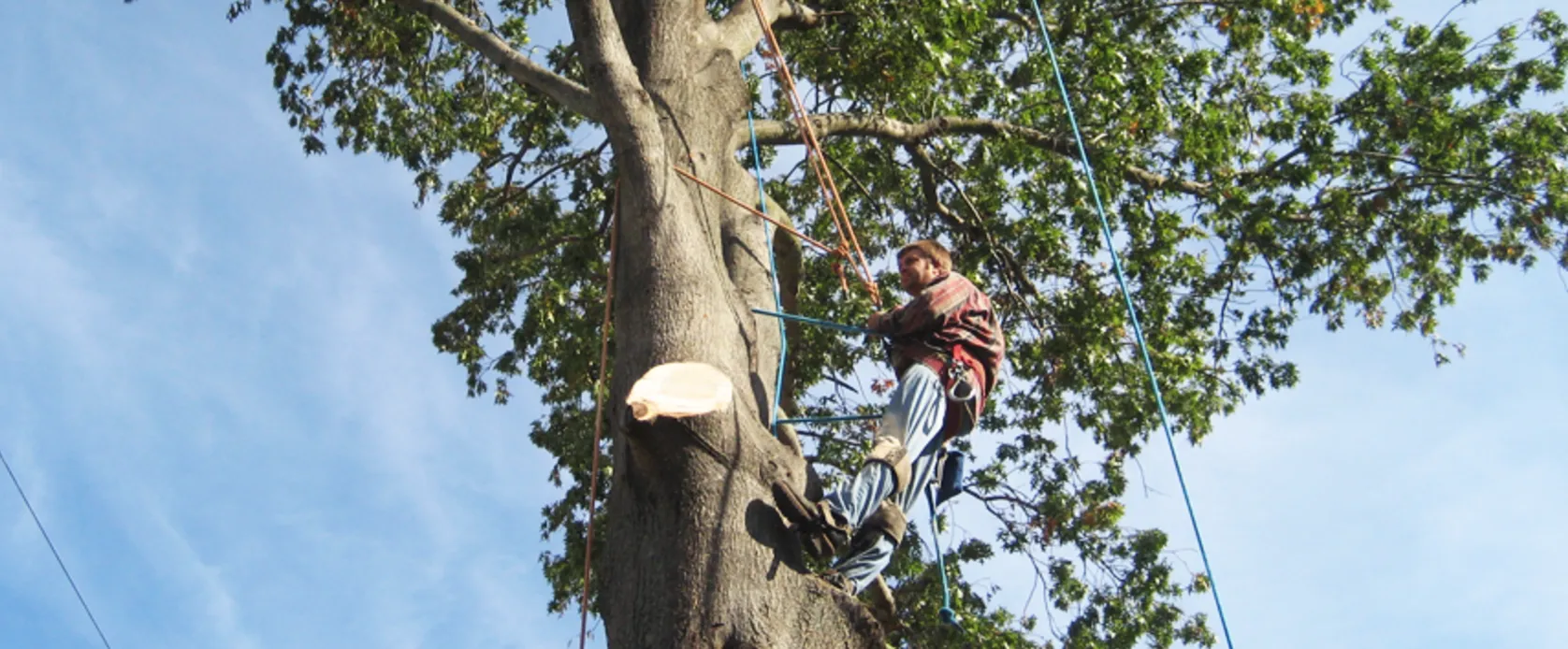
Standard bucket trucks — the primary aerial work platform for tree trimming in most communities — cannot operate safely on slopes steeper than about 5 degrees. That eliminates bucket truck access on the majority of Nashville properties. Our approach in Brown County is climbing-based. Our arborists access the canopy using ropes and harness systems that allow them to position themselves anywhere in the tree, regardless of what the ground below looks like. This is more labor-intensive than bucket truck work, but it produces the same quality of pruning and reaches trees that no truck could.
Equipment staging on Nashville properties requires advance planning. When a chipper truck or log truck cannot reach the work area, brush and wood must be rigged down, dragged, or carried to a staging point where equipment can access it. We assess access on every Brown County property during the estimate visit and build the access logistics into our pricing. There are no surprises on the job.
The density of the forest around Nashville properties adds another layer of complexity. Many homes here are built in small clearings within continuous woodland, surrounded on all sides by trees. Pruning a tree in this environment often means working in close proximity to adjacent trees whose branches are intertwined with the target tree. Drop zones are limited. Rigging is essential. Every branch removed must be lowered on a rope to a clear landing area, not dropped into the crowns of neighboring trees below.
Brown County State Park — over 16,000 acres of protected hardwood forest — borders many Nashville properties, and the transition from park forest to residential landscape is often seamless. Trees that grow at the boundary of your yard and the state park are subject to the same wind, ice, and pest pressures as any other tree, but their position at the forest edge makes them particularly vulnerable.
Managing Brown County's Dense Hardwood Canopy
Brown County has one of the richest hardwood forests in the eastern United States. The species mix — white oak, red oak, black oak, sugar maple, American beech, tulip poplar, shagbark hickory, and black walnut — represents the full diversity of Indiana's mature upland hardwood forest. Each species has distinct wood properties, growth habits, and pruning requirements.
White oak is the dominant species on Brown County ridgetops and upper slopes. It develops a broad, spreading crown with strong branch attachments and is one of the most wind-resistant species in our native forest. White oak needs relatively little pruning once it reaches mature form, but deadwood removal is a regular need. White oaks in the understory that suddenly gain full sun exposure — common when a neighboring tree is removed or dies — can develop extensive sun scald on bark that was previously shaded. Gradual crown thinning over multiple seasons, rather than aggressive one-time pruning, allows the tree to acclimate to the increased light without bark damage.
Red oak and black oak occupy mid-slope positions throughout Brown County. Both species are susceptible to oak wilt and must not be pruned during the April-through-July beetle season. Black oak in particular tends to develop narrow branch unions and included bark, making structural assessment a priority during any pruning visit. We flag structural concerns we observe during routine pruning so property owners can make informed decisions about whether supplemental support or future removal is warranted.
Sugar maple dominates the mesic lower slopes and cove positions in Brown County's terrain. These are the trees responsible for much of the fall color spectacle that draws visitors to the area each October. Sugar maples produce dense canopies that benefit from periodic thinning to improve air circulation and reduce the fungal leaf diseases — particularly tar spot and anthracnose — that are common in humid, sheltered positions. We prune sugar maples during late-winter dormancy, before sap flow begins in late February.
American beech is common in the shadier, moister positions throughout Brown County. Beech is slow-growing and long-lived, and it rarely needs aggressive pruning. What it does need is protection from bark damage. Beech bark is thin and smooth, and wounds on beech trunk and branches heal slowly and often serve as entry points for decay. We handle beech pruning with extra care to avoid trunk damage during climbing operations, using bark-protective cambium savers on all climbing anchor points.
Tulip poplar grows fastest on the deep, moist soils of Brown County's valley floors and north-facing slopes. These trees shoot upward rapidly, often reaching 80 feet in height within 40 years, but their branch unions are inherently weaker than those of oaks. Early structural pruning is valuable on any tulip poplar within reach of a structure, but on Nashville properties where dozens of poplars may surround the house, triage is necessary. We prioritize the trees that pose the greatest risk based on proximity, size, lean, and visible structural defects.
Edge Tree Pruning and Wind Protection in Nashville
One of the most important and least understood pruning concepts for Nashville property owners is the vulnerability of forest-edge trees. In a continuous forest, trees grow in mutual wind protection. Each tree is shielded on multiple sides by its neighbors, and the wind forces that reach any individual trunk are significantly reduced by the surrounding canopy. When a clearing is created — whether for a house, a driveway, or a yard — the trees at the new edge of that clearing lose their wind protection on one or more sides.
These edge trees are now exposed to wind speeds and turbulence they were never structurally prepared for. A red oak that grew 60 feet tall inside a dense stand had no need to develop a broad, wind-resistant crown because it was never exposed to significant lateral wind loading. Put that same tree at the edge of a clearing, and the first strong thunderstorm tests a structural design that was not built for the new conditions.
Edge trees need assessment and, in many cases, targeted pruning to improve their wind resistance. Crown thinning on the newly exposed side reduces the sail effect and allows wind to pass through rather than push against the canopy. Reduction of long, overextended branches that now have no neighboring canopy to limit their movement reduces the leverage those branches exert on their attachment points. Deadwood removal eliminates the brittle branches most likely to break first and strike whatever is below.
On Nashville properties where homes are built in forest clearings, the edge trees are often the largest and closest trees to the house. They are the trees most likely to cause damage if they fail, and they are the trees most likely to fail because of their new exposure. We recommend that every Nashville property owner have their edge trees assessed by an ISA-certified arborist within the first two years after any clearing operation — whether it was for new construction, a driveway expansion, or simply opening up a view corridor.
The opposite problem also exists in Brown County: trees that are crowded too tightly and competing for light. Crown competition between adjacent trees produces tall, skinny trunks with small crowns positioned only at the very top — a structurally unstable form that is highly vulnerable to snow and ice loading. Selective removal of competing trees, combined with crown development pruning on the retained specimens, creates a more stable, resilient canopy over time.
Pruning Programs for Nashville Vacation Properties
A significant percentage of Nashville and Brown County properties are vacation homes, weekend retreats, Airbnb rentals, and seasonal cabins. Owners are not on site full-time to notice when a tree develops a crack in a branch union, loses a limb in a summer storm, or shows the first signs of decline from disease or pest pressure. Problems that a full-time resident would spot and address promptly can go undetected for months or years on a part-time property.
We recommend that Nashville vacation property owners establish an annual pruning and assessment schedule. A single late-winter visit — timed during the dormant season when canopy structure is fully visible — allows our arborists to walk the entire property, inspect every tree within range of the house, driveway, and outdoor living areas, and perform any pruning work that is needed. Deadwood removal, structural corrections, and clearance pruning can all be accomplished in a single visit when the work is done on a consistent annual basis.
For properties with rental income, tree maintenance is also a liability management issue. A vacation rental with a dead limb hanging over the deck or a leaning tree above the parking area creates a risk that falls on the property owner. Documented annual care by a certified professional demonstrates the standard of care that protects both your guests and your financial exposure.
We can work on Nashville properties whether the owner is present or not. For remote property owners, we provide a detailed written report after each visit that documents the work performed, identifies any new concerns observed, and recommends follow-up actions. Photo documentation of significant findings is included as standard practice.
Nashville Tree Trimming You Can Count On
Bloomington Tree Service Pros has the equipment, climbing expertise, and species knowledge that Brown County's terrain demands. Our ISA-certified arborists are trained in climbing-based pruning techniques that allow us to work safely and effectively on Nashville's steep slopes, narrow access roads, and densely wooded properties where bucket trucks cannot reach.
We follow ANSI A300 Part 1 pruning standards and ANSI Z133 safety standards on every job. We never top trees. We make every cut at the branch collar. We do not use wound sealant. We respect the forest character that makes Brown County one of the most beautiful landscapes in Indiana, and we prune with the goal of keeping your trees healthy, safe, and structurally sound for decades to come.
Our crews carry full general liability and workers' compensation insurance, and we provide free on-site estimates for all Nashville and Brown County properties. We will drive your driveway, walk your property, and give you an honest assessment of what needs attention and what does not.
Call us at (812) 432-2013 to schedule your free estimate. Whether you live in Nashville full-time or visit on weekends, your trees need a professional who understands the unique conditions of Brown County.
Our Tree Trimming & Pruning Service Includes
- Structural pruning for young trees to establish a dominant leader and balanced scaffold branches
- Crown thinning to improve light penetration and air circulation without over-pruning
- Crown raising to provide clearance over rooflines, driveways, and pedestrian areas
- Deadwood removal — all dead, dying, and broken branches removed from the canopy
- Oak wilt prevention scheduling: oak pruning timed outside the April–July high-risk window
- Species-specific timing for maples, sycamores, tulip poplars, and fruit trees
- Vista pruning to open sightlines while preserving tree health and canopy structure
- Fruit tree renewal pruning to maximize yield and manage size in home orchards
Other Tree Services in Nashville
Need Tree Trimming & Pruning in Nashville?
Fill out the form at the top of this page to claim your $20 discount and get a free on-site estimate from our ISA-certified team.