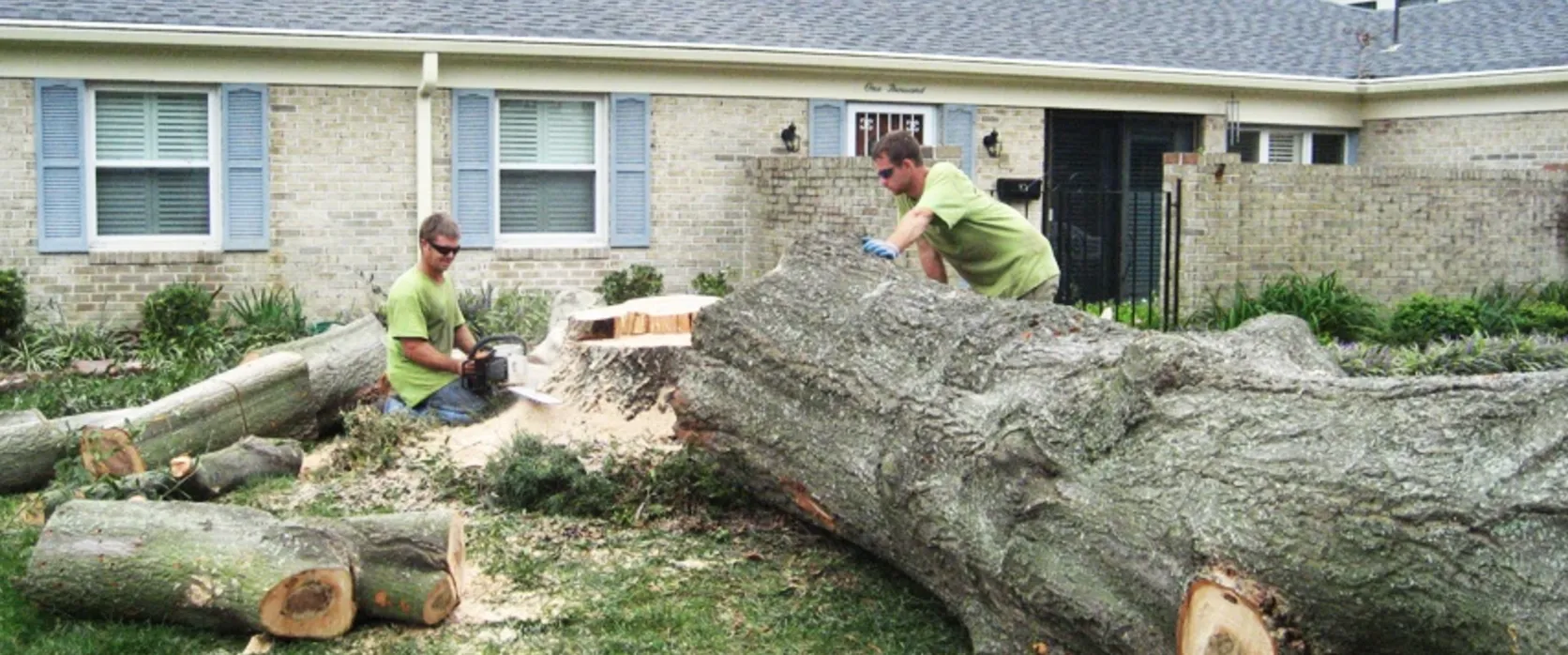
Tree Removal in Bedford
Expert tree removal for Bedford and Lawrence County — where shallow limestone bedrock creates unique challenges for every job.
$20 OFF Your Service
Submit the form to claim your discount. Mention this offer when we call to confirm your estimate. Valid for all Bedford properties.
The Fastest Way to Get Your Quote
Submit the form and we'll dispatch an estimator to your Bedford property — that's our promise.
It's easier for everyone. We might be up in your neighbor's tree. The form gets us your info so we can schedule your estimate right away.
Prefer to call? We're here at (812) 432-2013
Get Your Quote in 24 Hours
Fill this out and we'll send an estimator to your Bedford property.
How Bedford's Limestone Geology Affects Tree Removal
Bedford earns its title as the "Limestone Capital of the World" from the Indiana limestone industry that shaped this city, but that same geology shapes every tree removal we perform in Lawrence County. The limestone bedrock here is often significantly closer to the surface than in neighboring Monroe County, and that shallow bedrock fundamentally changes how trees grow, how they fail, and how they need to be removed.
When bedrock sits two to four feet below the surface, large trees cannot develop the deep taproot and lateral root systems they would in deeper soil. Instead, the root plate spreads broadly but shallowly, gripping a thin layer of soil above the rock. A 70-foot red oak with a root plate only three feet deep has a much higher center of gravity relative to its anchoring than the same species growing in deep alluvial soil along a river. The result is a measurably higher windthrow risk — trees in Bedford are more likely to uproot entirely during severe weather than trees of the same species and size growing in deeper soils elsewhere.
This shallow root structure also affects how we plan removals. When a tree with a shallow root plate needs to come down, we evaluate whether the root plate is compromised before deciding on a felling direction. A tree that appears to lean slightly north may actually have more root anchoring on the south side, making a southward fell safer despite the visual lean. We check root plate lift on the tension side, probe for soil depth with a rod, and look for pavement heaving or ground cracking that indicates the root plate has already begun to shift. These assessments are standard on every Bedford removal because the bedrock conditions here demand it.
The shallow bedrock also means that stump grinding after removal encounters rock sooner than expected. Our crews adjust grinding depth and approach for Lawrence County's limestone substrate, and we advise property owners upfront when bedrock will limit how deep we can grind.
Aging Canopy in Bedford's Historic Neighborhoods
Bedford's established neighborhoods along 16th Street, J Street, and Lincoln Avenue are defined by their mature tree canopy. Many of these trees were planted when the neighborhoods were developed 50 to 80 years ago, and they have grown into the large shade trees that give these streets their character. Red oak, sugar maple, white oak, and tulip poplar are the dominant species, with individual trees reaching 70 to 90 feet in height and trunk diameters of 24 to 36 inches.
Trees of this age and size require a different kind of attention than younger specimens. Internal decay is common in mature hardwoods, particularly where old pruning wounds, storm damage, or bark inclusions have allowed wood-decay fungi to colonize the heartwood. A tree can appear healthy from the outside — full canopy, green leaves, intact bark — while harboring a column of decay that has hollowed out 40 percent or more of the trunk cross-section. We use sounding techniques and, when warranted, resistograph testing to evaluate internal wood integrity on Bedford's large mature trees before recommending a course of action.
Co-dominant stems are another prevalent issue in Bedford's older canopy. A co-dominant stem forms when a tree develops two leaders of roughly equal size that emerge from the same point on the trunk. The junction between these stems often develops included bark — bark that is trapped inside the union rather than growing outward — which prevents the wood fibers from interlocking and creates a structural weak point. Co-dominant stems with included bark are the single most common failure mode we see in Bedford's mature trees during storm events. When a co-dominant stem splits, it typically takes half the tree's canopy with it, often onto a roof, vehicle, or utility line.
For trees with severe structural defects or advanced decay, removal is the responsible recommendation. We do not upsell removals — if a tree can be made safe through pruning, cabling, or other retention strategies, we will tell you. But when the risk profile has crossed the threshold where retention is no longer defensible, we explain why and provide a removal plan that addresses the specific conditions of the tree and its surroundings.
Tree Removal Near Structures and Utilities in Bedford
Bedford's residential lots, particularly in the historic core, are not large. Trees that were planted 60 years ago on what seemed like generous lots are now towering over houses, garages, sheds, and utility infrastructure at distances that leave very little room for conventional felling. A 70-foot tulip poplar standing 15 feet from a house cannot be felled away from the structure — its height exceeds the available clearance in every direction on a typical Bedford lot.
Sectional rigging is the standard approach for these confined removals. Our climber or lift operator begins at the top of the tree and works downward, removing limbs and trunk sections in controlled pieces. Each piece is attached to a lowering rope before the cut is made, and the rope runs through a friction device that controls the descent speed and placement. On Bedford properties where the tree overhangs the house, every piece comes off the tree on a rope — nothing is free-dropped over a structure.
Utility line proximity adds another layer of planning. Bedford's older neighborhoods have overhead electric, cable, and telephone lines running along the street and through alleys, and mature tree canopies frequently extend into or over these lines. We follow ANSI Z133 electrical hazard protocols for all work near energized conductors, maintaining minimum approach distances and using non-conductive tools and rigging when working within the defined hazard zone. When a tree is in direct contact with a primary distribution line, we coordinate with the utility provider to de-energize the line before any removal work begins.
For large removals in Bedford where rigging alone would be slow or where the tree's condition makes climbing unsafe, we bring in crane-assisted removal. The crane picks cut sections directly off the tree and sets them in a landing zone — typically the street or driveway — without any part of the tree swinging toward the house or utility lines. Crane access in Bedford's older neighborhoods requires advance planning for street closures and truck positioning, and we handle that coordination as part of the job.
Rural Lawrence County Tree Removal Beyond Bedford
Bedford is the population center of Lawrence County, but the removal work we do extends well beyond the city limits. Rural Lawrence County properties — particularly those bordering the Hoosier National Forest to the east and the rolling farmland to the west — present their own set of challenges and opportunities.
Large rural parcels often have mature hardwood stands that have grown without management for decades. Dead trees, dying trees, and trees with severe structural defects accumulate in these stands over time, creating a backlog of hazard trees that may threaten fence lines, outbuildings, equipment, or access roads. We handle multi-tree removal projects on rural Lawrence County properties efficiently by mobilizing a full crew with heavy equipment for a single trip rather than making repeated visits for individual trees.
The area around Spring Mill State Park and extending south toward Mitchell has some of the densest forest cover in Lawrence County. Properties here are surrounded by white oak, beech, sugar maple, and tulip poplar growing in a closed canopy. When a tree on one of these properties needs to come down, the surrounding forest often limits our felling options — there may be no clear drop zone without risking damage to adjacent trees that the property owner wants to keep. Directional felling using wedges and hinge-cutting techniques, combined with careful limb removal to reduce the crown weight before the fell, allows us to drop trees precisely into narrow openings in the canopy.
Emerald ash borer has left standing dead ash throughout rural Lawrence County, and these snags are a particular concern along driveways and near barns, shops, and other outbuildings. A dead ash that stands in the middle of a woodlot may not be an urgent priority, but a dead ash leaning over a driveway that your family uses daily is a different matter entirely. We help rural property owners prioritize which trees need immediate attention and which can be addressed on a longer timeline.
Bedford Tree Removal by ISA-Certified Professionals
Bloomington Tree Service Pros serves Bedford and all of Lawrence County from our Bloomington base, a 30-minute drive south on State Road 37. We bring ISA-certified arborists, ANSI A300 and Z133 compliant operations, and full general liability and workers' compensation insurance to every Lawrence County job. These are not marketing buzzwords — they are the professional standards that separate qualified tree removal from the unlicensed operators who show up with a pickup truck and a chainsaw.
ISA certification means our arborists have passed a rigorous examination covering tree biology, diagnosis, safety, and management, and they maintain that certification through ongoing continuing education. When we assess a Bedford tree for removal, we are evaluating it through the lens of professional training — root plate integrity, trunk soundness, canopy structure, lean analysis, and site-specific hazards including the shallow limestone bedrock that defines Lawrence County. That assessment informs a removal plan that accounts for every variable, not a guess based on how the tree looks from the street.
Full insurance is non-negotiable for legitimate tree removal. General liability covers damage to your property if something goes wrong during the operation. Workers' compensation covers our crew members if they are injured on the job. If a tree service working on your property does not carry both — and many do not — you as the property owner may be liable for injuries and damages. We provide proof of insurance on request before any work begins.
For Bedford property owners dealing with storm damage claims, we produce the documentation your insurer needs — timestamped photographs, written scope of work, and itemized invoices — and we can communicate directly with your claims adjuster.
Call us at (812) 432-2013 for a free on-site estimate on any tree removal in Bedford or Lawrence County. We will assess the tree, explain the removal approach, and provide a firm price with no surprises.
Our Tree Removal Service Includes
- Full hazard assessment including lean, root plate health, and proximity to structures or utility lines
- Crane-assisted removal for trees in tight spaces, over structures, or with no clear drop zone
- Sectional rigging and lowering for controlled piece-by-piece removal near fences, cars, and landscaping
- Emerald ash borer snag removal using specialized protocols for brittle, unpredictable dead wood
- Complete stump grinding to 8–12 inches below grade included or quoted separately as needed
- Thorough debris cleanup — all wood, brush, and chips hauled away or left as mulch on request
- City of Bloomington and Monroe County permit coordination handled by our team
- Insurance documentation and photo evidence prepared for homeowner insurance claims
Other Tree Services in Bedford
Need Tree Removal in Bedford?
Fill out the form at the top of this page to claim your $20 discount and get a free on-site estimate from our ISA-certified team.