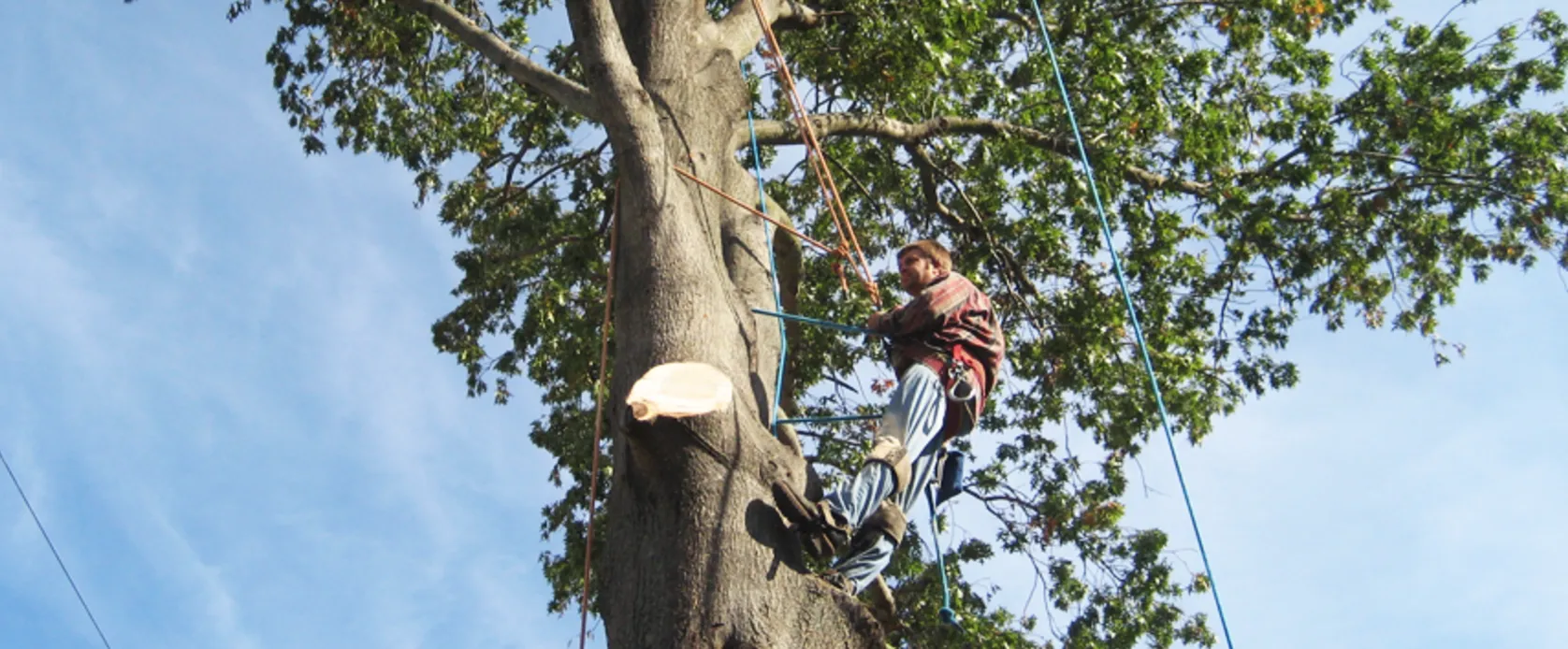
Tree Trimming & Pruning in Ellettsville
ISA-certified tree trimming for Ellettsville — from young subdivision trees to 60-year-old hardwoods along Edgewood Drive.
$20 OFF Your Service
Submit the form to claim your discount. Mention this offer when we call to confirm your estimate. Valid for all Ellettsville properties.
The Fastest Way to Get Your Quote
Submit the form and we'll dispatch an estimator to your Ellettsville property — that's our promise.
It's easier for everyone. We might be up in your neighbor's tree. The form gets us your info so we can schedule your estimate right away.
Prefer to call? We're here at (812) 432-2013
Get Your Quote in 24 Hours
Fill this out and we'll send an estimator to your Ellettsville property.
Why Ellettsville Trees Need Professional Pruning
Ellettsville is one of Monroe County's fastest-growing communities, and that growth is creating two very different pruning demands on the same five-mile stretch of State Road 46. On one side, newer subdivisions like Liberty Trail are filled with young shade trees that need structural training during their first 10 to 15 years. On the other, the older neighborhoods along IN-46 and Edgewood Drive have canopy trees planted 40 to 60 years ago that are now large enough to threaten rooflines, driveways, and utility service drops.
Both situations require professional attention, but for different reasons. A young red maple in a Liberty Trail yard needs early structural pruning to establish a strong central leader and prevent the co-dominant stems that cause catastrophic splits 20 years down the road. A mature white oak along Edgewood Drive needs deadwood removal, crown thinning for wind resistance, and careful inspection of old branch unions where included bark may be hiding a structural defect.
Ellettsville sits on the same limestone karst geology that defines all of Monroe County. The clay-heavy soils here retain water after spring rains, and shallow bedrock limits how deep root systems can anchor. When canopy trees carry excess dead weight or have dense, unpruned crowns that catch wind like a sail, those shallow root systems are far more likely to fail during the severe thunderstorms that roll through south-central Indiana from April through September. Pruning directly reduces the wind load a tree presents to a storm, and that reduction can be the difference between a tree standing and a tree coming through your living room ceiling.
The species mix in Ellettsville demands attention to timing as well. Red oak and white oak are dominant throughout the community, and both are vulnerable to oak wilt — a lethal vascular disease spread by sap beetles that are attracted to fresh pruning wounds during the warm months. We schedule all oak pruning outside the April-through-July high-risk window to eliminate that exposure. Sugar maples, the other major canopy species here, bleed sap heavily if pruned during spring sap flow, which is why we target late February through early March for maple work in this part of Indiana.
Common Pruning Scenarios in Ellettsville Neighborhoods
The most frequent pruning work we perform in Ellettsville falls into a handful of recurring patterns, each tied to the specific conditions of this community.
Crown raising is the single most requested service in Ellettsville's established neighborhoods. Mature sugar maples and red oaks along the IN-46 corridor have low scaffold branches that were never removed when the trees were young. Those branches are now 8 to 12 inches in diameter and hang low enough to scrape rooflines, block driveway clearance, and obstruct sidewalk passage. Removing a branch that size properly — cutting at the branch collar to allow natural wound closure — is not a homeowner job. It requires rigging to control the weight of the limb and prevent bark tearing down the trunk.
Deadwood removal is a constant need in Ellettsville's older canopy. Shagbark hickory is common here, and hickory produces dead branches prolifically as it matures. A dead hickory limb 3 inches in diameter falling from 50 feet hits the ground — or your car, or your child — with enough force to cause serious damage or injury. We remove all dead, dying, and broken branches from the canopy during a standard pruning visit. Once removed, the canopy is safer and the tree can redirect its resources into healthy growth.
Structural pruning on young trees is where we do some of our most impactful work in Ellettsville's newer developments. Builders often plant fast-growing species like red maple and tulip poplar that naturally develop multiple competing leaders. Without early intervention to select a single dominant leader and subordinate or remove competing stems, these trees grow into structurally compromised adults that split apart in storms. We recommend a first structural pruning visit within three to five years of planting, with follow-up every two to three years until the scaffold branch framework is permanently established.
Vista pruning is another request we handle regularly in Ellettsville, particularly for properties along ridgelines on the west side of town. Selective removal of lower branches or interior canopy opens sightlines to the surrounding countryside without sacrificing the tree's health or structural integrity. This is precise work — removing too much invites sun scald on previously shaded bark, and removing too little accomplishes nothing.
Pruning Schedules for Ellettsville's Tree Species
Timing matters as much as technique in tree pruning, and the species growing in Ellettsville each have distinct optimal windows.
Oaks demand the strictest scheduling discipline. Red oak and white oak should only be pruned during full dormancy — December through March — or after leaves are fully expanded in late summer, August through October. The April-through-July window is off-limits for live pruning cuts on oaks in Indiana because the sap beetles that vector oak wilt are most active during warm weather and are attracted to fresh wound tissue. We take this seriously. Oak wilt has been confirmed in multiple Indiana counties, and a single pruning cut at the wrong time of year can introduce a disease that kills an irreplaceable 80-year-old white oak.
Sugar maples are best pruned in late winter, ideally late February through early March in Monroe County's climate zone 6a. Pruning before sap flow begins prevents the heavy sap bleeding that occurs when maples are cut during active growth. Sap bleeding is not directly harmful to the tree, but it creates an unsightly mess on bark and pavement, attracts insects, and can mask the wound closure process that determines whether a cut heals properly.
Shagbark hickory is flexible on timing and can be pruned during dormancy or in summer after leaves have hardened off. Hickory is a slow-growing species that responds well to conservative pruning — removing dead and crossing branches while leaving the natural form intact. Avoid heavy pruning on hickory. These trees compartmentalize decay slowly compared to oaks and maples, so every cut should be deliberate and justified.
Tulip poplar, which grows aggressively throughout Ellettsville, tolerates pruning across a broad window but responds best to late-winter work. This species produces fast vertical growth that often requires corrective structural pruning to prevent the development of weak, narrow branch angles. Tulip poplars that are not structurally trained early will develop the tall, narrow crowns that split apart in ice storms — a common failure mode we see throughout Monroe County every winter.
We build pruning schedules for Ellettsville properties that account for every species on the lot. A single property might have oaks, maples, and hickories that each need work at different times of year. We coordinate these visits into a maintenance calendar that keeps your trees healthy and structurally sound without requiring you to track the details.
Storm Damage Prevention Through Structural Pruning in Ellettsville
South-central Indiana averages 45 to 50 thunderstorm days per year, and Monroe County sits squarely in the path of severe weather systems that move northeast from the Gulf states. Ellettsville properties take hits from straight-line winds, microbursts, and occasional tornadoes. Ice storms are a separate and equally destructive threat between November and March. Every one of these events tests the structural integrity of your trees.
The trees that fail during storms almost always have pre-existing structural defects that could have been identified and managed through pruning. Co-dominant stems — two leaders of roughly equal size growing from the same point — are the most common defect. Where two stems meet, bark often grows inward between them rather than forming a strong branch union. This included bark creates a seam that splits under wind or ice load. Identifying and addressing co-dominant stems through reduction pruning or, in some cases, installing a supplemental cable system, is one of the most effective storm-prevention measures available.
Crown thinning also plays a direct role in wind resistance. A dense, unpruned canopy acts as a solid surface in high winds, transferring enormous lateral force to the trunk and root system. Thinning the crown by selectively removing interior branches — typically 15 to 20 percent of the live canopy per visit — allows wind to pass through the canopy rather than pushing against it. The tree moves with the wind instead of resisting it, dramatically reducing the chance of uprooting or major limb failure.
Deadwood removal is the simplest and most immediately effective storm-prevention measure. Dead branches are brittle. They do not flex with wind. They snap and fall. In a thunderstorm producing 60-mph gusts, every dead branch in your canopy becomes a projectile. Removing them during a pruning visit eliminates that risk entirely.
For Ellettsville properties with mature canopy trees near structures, we recommend a pruning cycle of every three to five years focused specifically on storm readiness — deadwood removal, crown thinning, and structural defect management. This is not cosmetic work. It is risk reduction based on how Indiana storms interact with the species growing on your property.
Professional Tree Trimming for Your Ellettsville Property
Bloomington Tree Service Pros is based just minutes from Ellettsville, making this one of our fastest-response areas for both scheduled pruning and urgent storm-related work. Our ISA-certified arborists follow ANSI A300 Part 1 pruning standards on every job — the same standards used by municipal arborists, university programs, and professional tree care companies nationwide.
We do not top trees. We do not use wound sealant. We do not leave stubs or make flush cuts. Every pruning cut we make is placed at the branch collar, the anatomical point where the tree is best equipped to seal the wound and prevent decay from entering the trunk. These are not arbitrary preferences. They are evidence-based practices supported by decades of research into how trees respond to pruning injuries.
Our crews carry full general liability and workers' compensation insurance on every job site in Ellettsville. We provide free on-site estimates that include a walk-through of your property, species identification, and specific pruning recommendations for each tree. We are straightforward about what needs work now, what can wait, and what falls outside the scope of pruning and may require a different service.
Ellettsville is our backyard. We know the species, the soils, the weather patterns, and the neighborhoods. If your trees need professional attention — whether it is structural training for a newly planted red maple or deadwood removal from a 70-year-old white oak — call us at (812) 432-2013 to schedule your free estimate.
Our Tree Trimming & Pruning Service Includes
- Structural pruning for young trees to establish a dominant leader and balanced scaffold branches
- Crown thinning to improve light penetration and air circulation without over-pruning
- Crown raising to provide clearance over rooflines, driveways, and pedestrian areas
- Deadwood removal — all dead, dying, and broken branches removed from the canopy
- Oak wilt prevention scheduling: oak pruning timed outside the April–July high-risk window
- Species-specific timing for maples, sycamores, tulip poplars, and fruit trees
- Vista pruning to open sightlines while preserving tree health and canopy structure
- Fruit tree renewal pruning to maximize yield and manage size in home orchards
Other Tree Services in Ellettsville
Need Tree Trimming & Pruning in Ellettsville?
Fill out the form at the top of this page to claim your $20 discount and get a free on-site estimate from our ISA-certified team.