Emergency Storm Service in Bloomington
24/7 emergency tree service Bloomington and Monroe County property owners can call after severe storms, fallen trees, and storm damage tree removal Bloomington IN situations that cannot wait until morning. We respond fast, day or night.
$20 OFF Your Service
Submit the form to claim your discount. Mention this offer when we call to confirm your estimate.
The Fastest Way to Get Your Quote
Submit the form and we'll dispatch an estimator to your property — that's our promise.
It's easier for everyone. We might be up in your neighbor's tree. The form gets us your info so we can schedule your estimate right away.
Prefer to call? We're here at (812) 432-2013
Get Your Quote in 24 Hours
Fill this out and we'll send an estimator to your property.
Emergency Tree Service in Bloomington, Indiana
When a severe storm drops a tree on your roof at 2 a.m., or a massive oak splits across your driveway during a Monroe County ice event, the last thing you need is a voicemail. Bloomington Tree Service Pros provides emergency tree service in Bloomington, IN around the clock, every day of the year — including holidays. Our 24/7 live dispatcher answers immediately so a trained crew can be rolling toward your property within minutes of your call. Whether you are dealing with a tree on a power line, a limb through a window, or a trunk blocking your only exit, we respond to active hazards across Monroe County in 2 to 4 hours.
Call us now at (812) 432-2013. A live person answers 24 hours a day, 7 days a week, 365 days a year. No automated systems. No after-hours call centers. No waiting until morning while a compromised tree continues to press against your structure.
Bloomington's Severe Weather and Storm Damage Risk
Bloomington sits at one of the most meteorologically active crossroads in the Midwest. Gulf moisture moving north out of the Mississippi and Ohio River valleys collides with cold fronts dropping down from the Great Lakes, and Monroe County ends up directly in the path of that conflict on a regular basis. The National Weather Service office in Indianapolis issues severe thunderstorm warnings for our county more frequently than most residents realize, and the storm season stretches far longer than people expect.
From April through September, Bloomington experiences its primary severe thunderstorm season. Supercell thunderstorms capable of producing straight-line winds above 60 mph, large hail, and embedded tornadoes move through the area multiple times each year. These are the events that send large limbs through roofs, topple poorly anchored trees, and deposit trunks across roads, driveways, and parked vehicles. A single storm can generate dozens of emergency calls across the city in the span of a few hours.
Winter brings a different threat. South-central Indiana averages 2 to 4 significant ice storm events per season. Ice loading is deceptively destructive — a one-inch coating of freezing rain can increase the effective weight of a branch by 30 times. Branches and entire crowns that would have survived a powerful summer windstorm may fail completely under ice load, particularly in trees already stressed by disease, drought, or previous storm damage. The ice events that hit Bloomington in recent years have caused widespread damage across older residential neighborhoods, where large mature trees overhang homes and utility lines.
The neighborhoods closest to Indiana University carry additional risk due to tree age. Prospect Hill, Elm Heights, Bryan Park, and Seminary Square are home to oaks and maples that are 80 to 100 years old. These trees are irreplaceable community assets, but their age and root systems — often navigating below century-old infrastructure — make them more vulnerable to structural failure during severe weather than younger trees. When one of these grand specimens comes down, it comes down with tremendous force and mass.
Our Emergency Response Process
Speed matters in a tree emergency, but so does doing the job correctly the first time. Bloomington Tree Service Pros follows a structured response process that balances urgency with safety and thoroughness.
Step 1 — Live Dispatch, Immediate Assessment: When you call (812) 432-2013, a live dispatcher answers — not a recording. Our dispatcher collects essential information about your situation: the location of the tree, whether it is contacting a structure or utility line, whether anyone is injured or trapped, and whether the hazard is actively worsening. This intake allows us to dispatch the right crew configuration and equipment for your specific situation rather than sending a generic response.
Step 2 — Duke Energy Coordination for Tree-on-Wire Situations: If a tree or large limb has come down on a power line, our dispatch team immediately advises you to keep all people and pets well away from the area. Do not assume a downed line is de-energized. We coordinate directly with Duke Energy — reachable at 1-800-521-2232 — to ensure power is safely managed before our crew begins work. Our teams are trained in ANSI Z133 electrical hazard protocols and will not begin extraction work near energized conductors. Your safety, and the safety of our crew, depends on following this sequence without exception.
Step 3 — Hazard Mitigation and Structural Protection: Once our crew arrives, the first priority is stopping further damage. If a tree has breached your roof, we deploy structural tarping to seal the opening against additional weather infiltration while we work. A temporary tarp properly installed can mean the difference between a manageable repair and a water-damaged interior. We document the tarp installation with timestamped photos, which becomes part of your insurance claim package.
Step 4 — Safe Extraction Using Sectional Rigging: Emergency tree removal is not the same as standard removal. The tree is often already compromised structurally, under tension, or leaning against a structure in a way that makes straightforward cutting dangerous. Our ISA-certified arborists use sectional rigging techniques to dismantle trees in controlled pieces, preventing secondary damage to the structure the tree is leaning against. This approach takes longer than chain-sawing from the bottom, but it is the method that prevents a roof repair job from becoming a complete structural replacement.
Step 5 — Complete Insurance Documentation: Before we leave your property, our crew produces a complete documentation package for your insurance claim. This includes timestamped photographs of the tree's pre-removal position, the contact point with any structure or vehicle, the condition of the tree, and the site after removal. We have worked extensively with claims adjusters from State Farm, Allstate, Indiana Farm Bureau, and Nationwide, and we understand exactly what documentation those companies require to process storm damage claims efficiently.
Common Emergency Tree Situations in Bloomington
Every emergency is different, but certain scenarios repeat across Monroe County after severe weather. Understanding these common situations helps you know what to expect and how to communicate the hazard to our dispatcher.
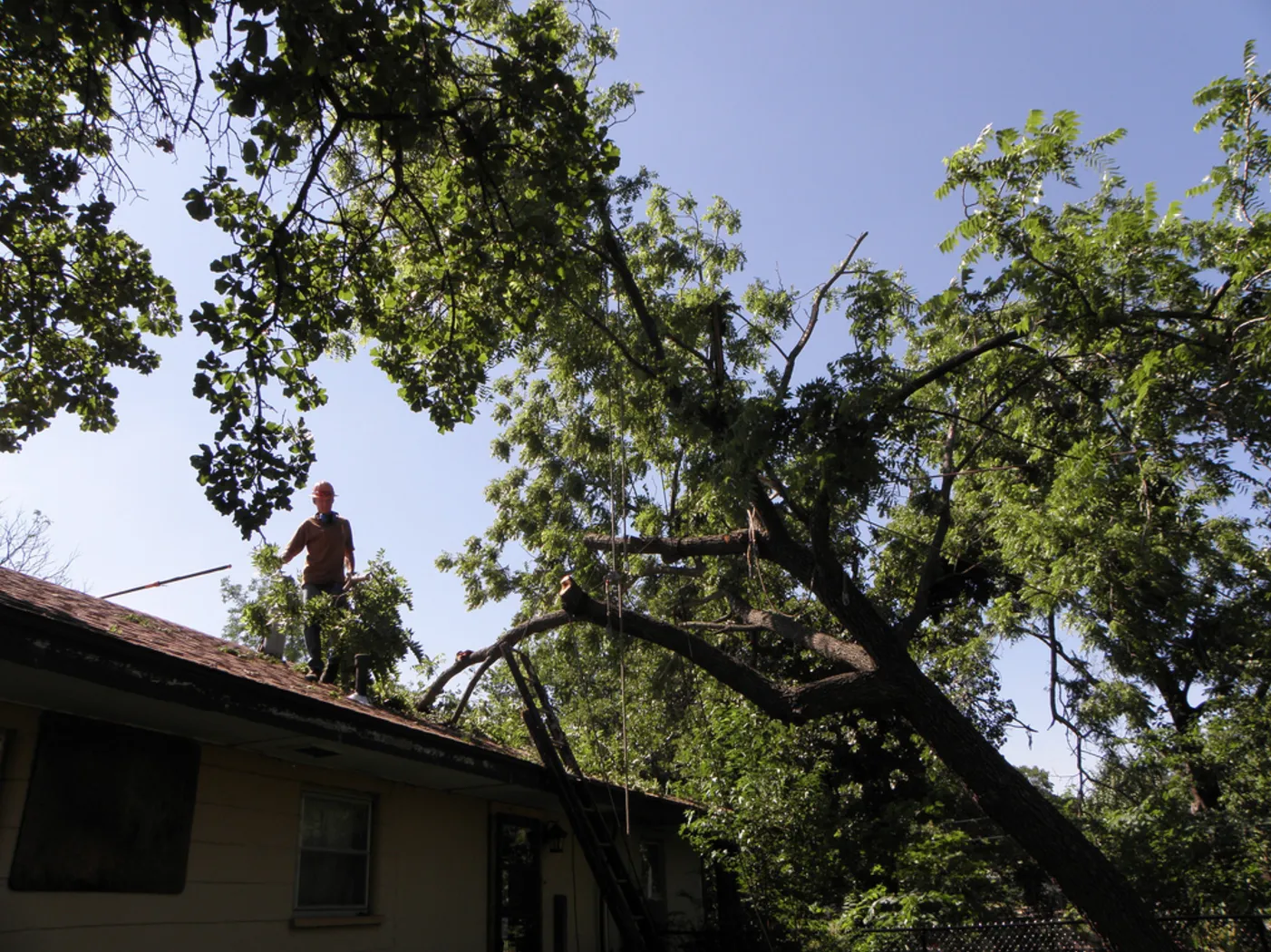
Fallen Tree on House or Roof: A tree or major limb resting on a roof is one of the most time-sensitive emergencies we handle. The weight of even a modest-sized limb can cause progressive damage as it settles, and precipitation entering through a breach accelerates that damage rapidly. Our response prioritizes getting a tarp over any roof breach while simultaneously beginning safe extraction. Do not attempt to push or pull the tree yourself — shifting a resting tree unpredictably can cause it to drop through the weakened structure below it.
Storm Damage Tree Removal After Wind Events: Straight-line wind events are the most common driver of storm damage tree removal in Bloomington. These storms can uproot entire trees or snap trunks 10 to 15 feet above ground, leaving root plates raised and soil disturbed. Uprooted trees with raised root plates create a secondary hazard — the root ball is under tension and can drop suddenly if the tree shifts. Our crews are trained to assess and control this tension before beginning removal work.
Tree on Vehicle: A tree or limb resting on a vehicle requires careful extraction to avoid additional damage to the vehicle and to create a complete record for the vehicle owner's insurance claim. We document the vehicle's condition before and after extraction. If the vehicle cannot be moved until the tree is removed, we work with the vehicle owner and their insurer to coordinate the sequence correctly.
Blocked Driveway or Access Road: A fallen tree blocking a driveway or private road creates an access emergency, particularly for households with medical needs or where emergency vehicle access could be compromised. We prioritize creating a passable lane as quickly as possible, even if full removal and cleanup must follow in a second phase.
Hazardous Hanging Limbs: After a storm passes, "widow makers" — partially broken limbs hanging in the canopy — are an underappreciated danger. A limb that survived the storm attached by a thin strip of bark can drop without warning hours or days later. If you identify hanging limbs on your property after a storm, keep the area below them clear and call us for evaluation. These situations are time-sensitive, especially with children, pets, or high-traffic areas below.
Ice Storm Branch Failure: Ice storm damage in Bloomington often produces a different pattern than summer windstorm damage. Rather than whole-tree failures, ice loading typically causes multiple large branches to fail across a single tree or across many trees simultaneously. The cleanup scope after a significant ice event can be enormous, and our dispatch team coordinates crew scheduling to address the highest-hazard situations — trees on structures and blocking access — before moving to cleanup work.
Insurance Claims and Storm Damage Documentation
One of the most stressful parts of a tree emergency is navigating the insurance claim process while simultaneously dealing with property damage. Bloomington Tree Service Pros has extensive experience assisting homeowners through this process, and we are proactive about producing the documentation your insurer needs.
Most standard homeowners insurance policies in Indiana cover tree removal when a tree has fallen and caused direct damage to an insured structure — your home, a detached garage, a fence, or a vehicle covered under your policy. The key qualifier is "direct damage." A tree that falls in your yard without hitting a structure is typically not covered for removal cost, though your policy's specifics may vary. We strongly recommend reviewing your policy's tree and storm damage provisions before an emergency, so you understand your coverage in advance.
When you file a storm damage claim, your adjuster will need:
• Photographs of the tree in its fallen position showing the contact point with the structure
• Documentation of any pre-existing property damage versus storm-caused damage
• An itemized estimate or invoice from the tree service company
• Photographs of the site after removal
• Evidence of emergency mitigation measures taken, such as structural tarping
We provide all of this documentation as a standard part of our emergency response. Our invoices are formatted to meet the requirements of major insurers operating in Indiana, including State Farm, Allstate, Indiana Farm Bureau, and Nationwide. If your adjuster has specific documentation requirements, let us know and we will work to meet them.
One important note about timing: emergency tree removal is billable under your claim regardless of whether it happens before or after your adjuster visits the site. However, if your insurer requests that you not alter the scene before an adjuster inspection, communicate that to us when you call. We can often provide immediate hazard mitigation — securing tarps, stabilizing the tree — without beginning full extraction until the adjuster has documented the scene.
What to Do While Waiting for Our Crew
The period between calling us and our crew arriving is the most important time to stay calm, stay safe, and avoid making the situation worse. Here is exactly what we advise:
Evacuate the Danger Zone: Move all people and pets away from the tree, any structure it is contacting, and any downed utility lines. Do not re-enter a space beneath a tree that has partially failed — secondary failure can happen with no warning. Keep a distance of at least twice the height of the tree from any downed power line.
Document Before You Touch Anything: If it is safe to do so from a distance, take photographs and video of the tree in its current position. Walk around the perimeter of the damage and capture it from multiple angles. This documentation is valuable for your insurance claim and supplements what our crew will capture when they arrive. Use your phone's timestamp function to confirm when the photos were taken.
Call Your Insurance Company: You can begin the claims process by calling your insurance company's 24-hour claims line even before our crew arrives. Most major insurers have after-hours claims intake. Filing promptly can accelerate your claim timeline. When you call, note the claim number you receive and have it available for our crew when they arrive.
Do Not Attempt DIY Removal: We understand the impulse to start clearing debris yourself. Resist it. A tree that has partially failed is under unpredictable mechanical stress. Chain saws in the hands of someone unfamiliar with tension and compression cuts are responsible for serious injuries every storm season. Leave the cutting to our crew. If you need a lane through your driveway and a branch is completely on the ground and clearly stable, moving debris by hand is generally fine. But do not attempt to cut or move any tree or limb that is still leaning, hanging, or contacting a structure.
Secure the Inside of Your Home: If a tree has breached your roof or a window, move valuables, electronics, and furniture out of the affected area. Place buckets under active drips. If the breach is large and precipitation is entering, consider covering affected furnishings with tarps or plastic sheeting from the inside while you wait. Our crew will address the structural tarp on the exterior as soon as they arrive.
What's Included
- 24/7/365 live dispatcher — real crew response, not a voicemail, for every emergency call
- Rapid response to all Monroe County communities including Bloomington, Ellettsville, and Stinesville
- Structural tarping of roof breaches to prevent water intrusion while repairs are arranged
- Complete documentation of all storm damage with timestamped photos for insurance claims
- Hazardous limb removal from structures using rigging systems that prevent secondary damage
- Driveway and road clearance for blocked access — priority response for medical necessity situations
- Coordination with Duke Energy and Indiana utility providers for tree-on-wire situations
- Insurance carrier communication and direct adjuster coordination upon request
Key Benefits
- Immediate response when a tree is actively threatening life safety or causing ongoing structural damage
- Prevent rain intrusion through a compromised roof while the insurance and repair process begins
- Restore driveway and road access quickly for families, emergency vehicles, or medical needs
- Professional documentation that supports a faster, more complete insurance settlement
- Avoid the additional structural damage that occurs when heavy debris sits on a roof for days
- Expert handling of utility-entangled trees that require coordination with Duke Energy
- Peace of mind knowing ISA-certified professionals are managing a dangerous, high-stress situation
- Single point of contact for tree removal, tarping, and insurance documentation after a storm
Emergency Storm Service Service Areas
We provide emergency storm service services throughout Bloomington and the surrounding communities:
Frequently Asked Questions
How quickly can you respond to an emergency tree call in Bloomington?
For active hazards — trees on structures, trees on power lines, trees blocking access routes — our target response time for Monroe County is 2 to 4 hours from your call. Response time can extend during widespread storm events when multiple crews are deployed simultaneously across the county. Our dispatcher will give you an honest estimated arrival window when you call and will update you if conditions change.
Do you charge extra for after-hours emergency service?
Yes. After-hours emergency response carries a surcharge of 20 to 50 percent above our standard daytime rates, depending on the time of call and crew requirements. This is standard across the industry and reflects the real cost of maintaining 24/7 staffing capacity. Our dispatcher will give you a clear explanation of applicable surcharges before committing your crew. We believe in transparent pricing, especially in stressful situations.
What if a tree has come down on a power line?
Do not approach the area. Keep everyone at least one full tree-length away from any downed line and assume it is energized until Duke Energy confirms otherwise. Call us at (812) 432-2013 and report the situation to Duke Energy at 1-800-521-2232. Our crews are trained in ANSI Z133 electrical hazard protocols and will not begin extraction work on tree-on-wire situations until the line has been safely managed by utility personnel. Your safety comes first, every time.
Will my homeowners insurance cover emergency tree removal in Bloomington?
In most cases, yes — if the tree has fallen and caused direct damage to an insured structure such as your home, garage, or fence. Indiana homeowners policies typically cover emergency tree removal under the dwelling or other structures coverage when a covered peril, such as a windstorm, caused the tree to fall. Coverage for tree removal alone, without direct structural damage, varies significantly by policy. We recommend reviewing your specific policy and calling your insurer's claims line to confirm coverage before authorizing work if time permits.
Are your arborists certified and insured?
Yes. Bloomington Tree Service Pros employs ISA-certified arborists and is fully licensed and insured to operate in Indiana. Our certification through the International Society of Arboriculture reflects ongoing education in tree care best practices, including emergency response, rigging, and hazard assessment. Our liability insurance and workers' compensation coverage protect you as a property owner. We carry documentation of our credentials and insurance on every job and are happy to provide copies upon request.
What neighborhoods in Bloomington do you serve for emergency calls?
We provide 24-hour emergency tree removal throughout Bloomington, Indiana and all of Monroe County. This includes all Bloomington neighborhoods — Prospect Hill, Elm Heights, Bryan Park, Seminary Square, McDoel Gardens, Broadview, Sherwood Oaks, and all areas north, south, east, and west of the city. We also serve Ellettsville, Stinesville, and surrounding Monroe County communities. If you are unsure whether your address falls within our response area, call us and our dispatcher will confirm immediately.
Can you help me understand what to say when I call my insurance company after storm damage?
Absolutely. Our crew leads have extensive experience working alongside insurance adjusters and can walk you through what your insurer typically needs to process a storm damage claim efficiently. We provide itemized invoices, timestamped photographic documentation, and written descriptions of the hazard and work performed. If your adjuster has specific questions about our scope of work or our assessment of the damage, they are welcome to contact us directly. We consider thorough insurance support to be a core part of our emergency service, not an extra.
Ready for Emergency Storm Service?
Fill out the form at the top of this page to claim your $20 discount and get a free on-site estimate from our ISA-certified team.
Prefer to call?
We're happy to talk through your emergency storm service project on the phone.
Fully Insured
For your peace of mind
Fast Response
We value your time