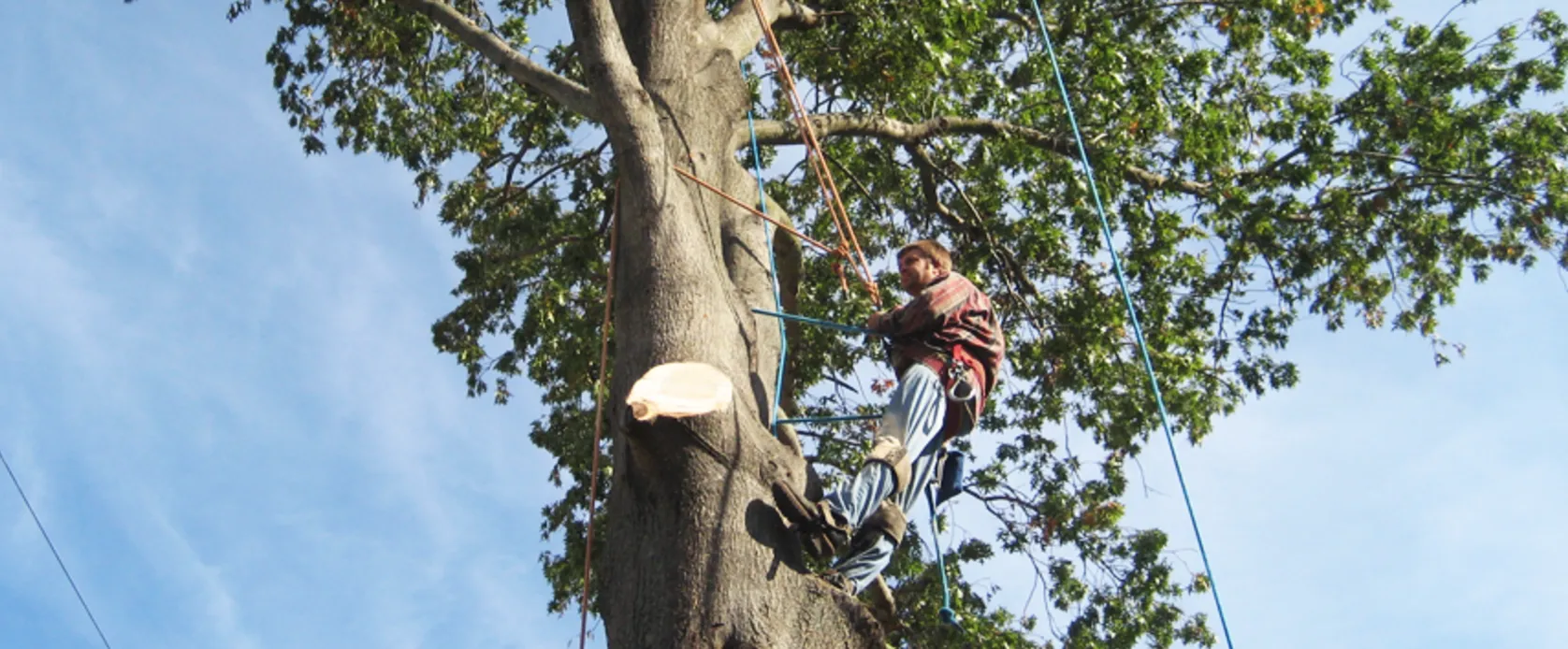
Tree Trimming & Pruning in Martinsville
ISA-certified tree trimming for Martinsville — from the White River sycamores to the courthouse square canopy.
$20 OFF Your Service
Submit the form to claim your discount. Mention this offer when we call to confirm your estimate. Valid for all Martinsville properties.
The Fastest Way to Get Your Quote
Submit the form and we'll dispatch an estimator to your Martinsville property — that's our promise.
It's easier for everyone. We might be up in your neighbor's tree. The form gets us your info so we can schedule your estimate right away.
Prefer to call? We're here at (812) 432-2013
Get Your Quote in 24 Hours
Fill this out and we'll send an estimator to your Martinsville property.
Tree Trimming for Martinsville's Evolving Landscape
Martinsville sits at a crossroads. The completion of I-69 between Bloomington and Indianapolis has turned Morgan County into one of the fastest-growing areas in south-central Indiana, and that growth is reshaping the landscape in real time. New subdivisions and commercial developments are pushing into wooded areas south and east of town, while the established neighborhoods around the Morgan County Courthouse and along the White River corridor are home to mature canopy trees that have been growing for generations.
These two environments present fundamentally different pruning needs. In the newer developments along the I-69 corridor, the priority is structural pruning on young trees that were either planted during construction or preserved from the original woodland. Trees that survived construction often carry hidden damage — root zone compaction from heavy equipment, grade changes that buried the root flare, or bark injuries from machinery strikes. These trees may look healthy for the first two or three years after construction, then begin a slow decline as the damage manifests. Early identification through professional assessment, combined with corrective pruning to reduce canopy demand on a compromised root system, gives these trees the best chance of long-term survival.
In Martinsville's established neighborhoods — the residential streets surrounding the courthouse, the older homes along the White River — the pruning need is different. These properties have mature sugar maples, red oaks, and white oaks that are 40 to 70 years old. Many have never received professional pruning. Their canopies are full of deadwood, crossing branches, and structural defects that have been developing unchecked for decades. A single professional pruning visit can address years of accumulated issues and dramatically reduce the risk of storm damage.
The White River runs directly through Martinsville, and the riparian corridor along the river is dominated by species that grow fast, large, and structurally complex. This creates a specific set of pruning challenges that defines tree care along Martinsville's riverfront properties.
Managing Sycamores and Cottonwoods Along Martinsville's White River
The White River corridor through Martinsville is lined with American sycamores and eastern cottonwoods — two species that grow to enormous size, produce massive horizontal branches, and present unique pruning challenges that most homeowners have never encountered.
American sycamore is one of the largest native trees in eastern North America. Mature specimens in the Martinsville river corridor reach 80 to 100 feet in height with trunk diameters exceeding three feet. Their canopy architecture features long, heavy lateral branches that extend outward from the trunk at near-horizontal angles. These lateral branches produce tremendous leverage at the point of attachment, and as they grow longer and heavier over decades, the structural capacity of the attachment point may be exceeded. The result is a sudden, catastrophic limb drop — sometimes on a calm, windless day — that can destroy anything below.
Crown reduction on large sycamore laterals is the primary pruning strategy for managing this risk. By shortening an overextended lateral branch back to a strong secondary branch — reducing the lever arm and the total weight — we bring the load back within the structural capacity of the branch union. This is precise work. The reduction cut must be made to a lateral branch that is at least one-third the diameter of the branch being removed, or the cut will function as a heading cut and trigger dense water sprout growth.
Eastern cottonwood grows even faster than sycamore and produces a sprawling, irregular crown with brittle wood that is notoriously prone to storm damage. Cottonwood branches break easily in wind and ice, and the species sheds limbs as a normal part of its growth habit. Properties with large cottonwoods near structures face an ongoing management challenge. Regular crown cleaning — removing dead, dying, and weakly attached branches — reduces the volume of material likely to come down in a storm, but it does not change the fundamental brittleness of the species. For cottonwoods in high-risk positions directly over homes or parking areas, we sometimes recommend a phased removal-and-replacement strategy rather than an indefinite cycle of pruning a tree that will never be structurally reliable.
Sycamore anthracnose is a fungal disease common in Martinsville's river corridor that causes premature leaf drop and twig dieback, particularly in cool, wet springs. While pruning does not cure anthracnose, improving air circulation through crown thinning reduces the humid conditions within the canopy that favor fungal development. Combined with removing dead twigs and branches where the fungus overwinters, pruning is part of an integrated management approach for affected sycamores.
Structural Pruning for Martinsville's New and Historic Properties
Structural pruning is the practice of training a tree's branch architecture during its first 10 to 15 years to create a strong, resilient framework that will carry the tree safely through decades of Indiana weather. It is the single most cost-effective tree care service available, and it is especially relevant in Martinsville where new construction is putting young trees in the ground at a pace that exceeds the area's capacity for professional follow-up care.
On a newly planted shade tree, structural pruning means establishing a single dominant leader — one central stem that extends from the base to the top of the tree without competition. It means selecting the permanent scaffold branches — typically three to five well-spaced branches with wide attachment angles — and removing or subordinating competing branches that would create structural problems later. It means identifying co-dominant stems early, when one can be removed with a pruning saw, rather than waiting until the competing stems are 10 inches in diameter and require a crane to address.
The species commonly planted in Martinsville's new developments — red maple, pin oak, tulip poplar — are all species that naturally develop structural problems if left unpruned. Red maple is prone to producing multiple leaders and branches with narrow, included-bark unions. Pin oak develops a dense, twiggy interior that retains dead branches for years. Tulip poplar grows so fast that competing stems can go from manageable to dangerous in just a few seasons.
For Martinsville's established neighborhoods, structural pruning takes a different form. On a mature tree, the goal is not to create new structure but to manage the structure that exists. This means identifying the defects — co-dominant stems with included bark, overextended laterals, heavy limbs growing directly over the roofline — and addressing them through reduction cuts, subordination pruning, or in some cases supplemental cabling systems that redistribute load away from a weakened attachment point.
The Morgan-Monroe State Forest south of Martinsville is a reminder of what Indiana's native hardwood forest looks like when it develops without structural management. In a forest setting, natural pruning occurs as shaded lower branches die and fall off. In a residential setting, trees receive full sunlight on all sides and retain their lower branches indefinitely, creating canopy forms that the species did not evolve to support. This is why residential trees need human intervention to develop safe, sustainable structure.
Commercial Tree Trimming in Martinsville's I-69 Corridor
The I-69 corridor has brought significant commercial development to Martinsville and southern Morgan County. Shopping centers, medical office buildings, restaurants, gas stations, and hotels line the highway exits and approach roads, and every one of these properties has landscape trees that require professional management.
Commercial tree trimming differs from residential work in several important ways. Liability exposure is higher because the trees are in areas with constant public foot traffic and vehicle traffic. A dead limb that falls on a customer's car in a parking lot or strikes a pedestrian on a commercial sidewalk creates an immediate legal and financial problem for the property owner. Commercial property managers and business owners have a duty of care that requires reasonable maintenance of trees on their property, and demonstrating that duty through regular professional pruning by ISA-certified arborists is both good practice and good legal defense.
Timing and scheduling are more constrained on commercial properties. Work often needs to happen during off-hours — early morning, evening, or weekends — to avoid disrupting business operations and customer access. Debris management must be immediate and thorough. We do not leave a commercial site with brush piles or wood chips scattered across a parking lot.
Clearance requirements on commercial properties are typically more stringent than on residential ones. Building codes and ADA requirements dictate minimum vertical clearance over sidewalks and parking areas. Trees that encroach on signage, lighting fixtures, security cameras, or building facades need clearance pruning that maintains the tree's health while meeting the functional requirements of the commercial site.
We serve commercial properties throughout Martinsville and Morgan County on scheduled maintenance contracts that provide regular pruning, deadwood removal, and hazard assessment at predetermined intervals. These contracts ensure consistent care, documented maintenance history for liability purposes, and predictable annual budgeting for tree care expenses.
Schedule Your Martinsville Tree Trimming
Bloomington Tree Service Pros serves Martinsville and all of Morgan County with ISA-certified arborists who follow ANSI A300 Part 1 pruning standards. Whether you need structural training for young trees in a new subdivision, crown management on the massive sycamores along the White River, or commercial maintenance along the I-69 corridor, our crews bring the expertise and equipment to do the work correctly.
We never top trees. We never use wound sealant. We never remove more than 25 percent of a mature tree's live canopy in a single visit. These are not just best practices — they are the standards that protect your trees from the permanent damage caused by improper pruning. A topped tree does not recover. It produces dense clusters of weakly attached sprouts that are far more dangerous than the original canopy, and the massive wounds left by topping cuts serve as entry points for decay that shortens the tree's life by decades.
Every crew member on our Martinsville jobs carries the insurance coverage you should expect from a professional tree care company: full general liability and workers' compensation. We provide free on-site estimates for residential, commercial, and municipal properties throughout Morgan County.
Call us at (812) 432-2013 to schedule your free estimate. We are 35 minutes from Martinsville and maintain a regular service presence in Morgan County throughout the year.
Our Tree Trimming & Pruning Service Includes
- Structural pruning for young trees to establish a dominant leader and balanced scaffold branches
- Crown thinning to improve light penetration and air circulation without over-pruning
- Crown raising to provide clearance over rooflines, driveways, and pedestrian areas
- Deadwood removal — all dead, dying, and broken branches removed from the canopy
- Oak wilt prevention scheduling: oak pruning timed outside the April–July high-risk window
- Species-specific timing for maples, sycamores, tulip poplars, and fruit trees
- Vista pruning to open sightlines while preserving tree health and canopy structure
- Fruit tree renewal pruning to maximize yield and manage size in home orchards
Other Tree Services in Martinsville
Need Tree Trimming & Pruning in Martinsville?
Fill out the form at the top of this page to claim your $20 discount and get a free on-site estimate from our ISA-certified team.