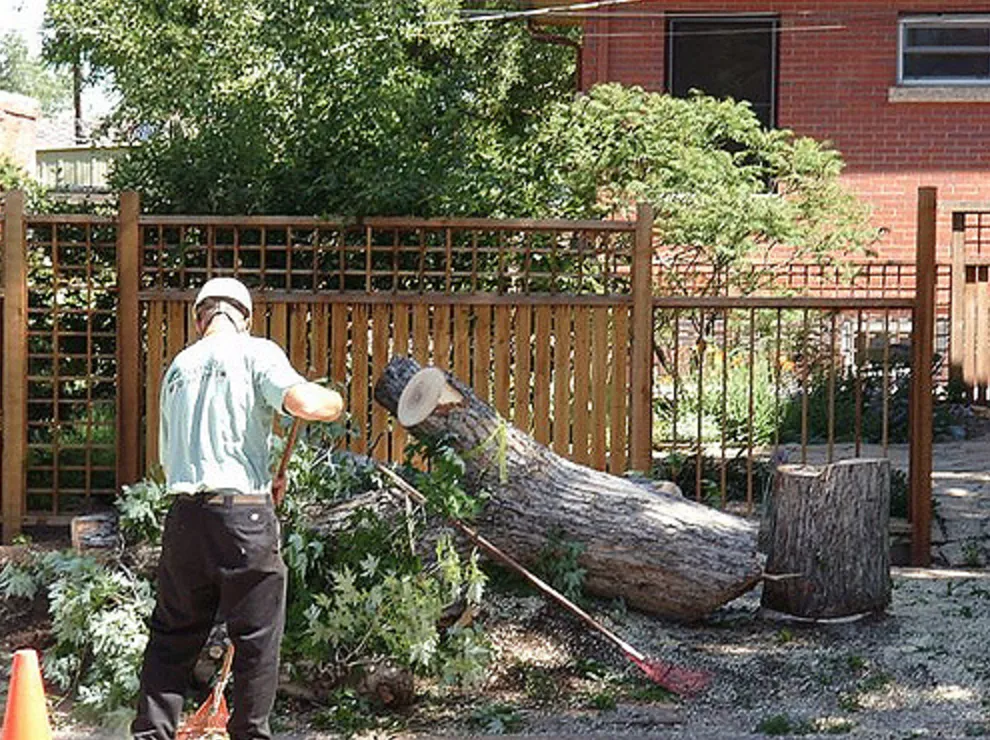
Stump Grinding in Bloomington
Professional stump grinding Bloomington IN property owners depend on to fully eliminate tree stumps, prevent regrowth, and restore usable yard space. We grind to well below grade so you can replant, sod, or build over the spot.
$20 OFF Your Service
Submit the form to claim your discount. Mention this offer when we call to confirm your estimate.
The Fastest Way to Get Your Quote
Submit the form and we'll dispatch an estimator to your property — that's our promise.
It's easier for everyone. We might be up in your neighbor's tree. The form gets us your info so we can schedule your estimate right away.
Prefer to call? We're here at (812) 432-2013
Get Your Quote in 24 Hours
Fill this out and we'll send an estimator to your property.
Stump Grinding in Bloomington, Indiana
If you have a tree stump taking up space in your yard, stump grinding in Bloomington IN is the fastest, cleanest, and most effective way to reclaim that ground. At Bloomington Tree Service Pros, our ISA-certified arborists use professional-grade grinding equipment to eliminate stumps quickly — leaving your property clean, safe, and ready for whatever comes next. Whether you have one stubborn oak stump or a dozen leftover from a recent clearing job, we serve all of Bloomington and Monroe County with honest pricing and reliable results.
Why Stump Grinding Is Important in Bloomington
Leaving a stump in the ground after a tree is removed might not seem like a big deal at first. But in Bloomington's warm, humid climate, that stump becomes a problem faster than most homeowners expect. Understanding the local environment helps explain why prompt stump removal matters here more than in cooler, drier parts of the country.
Monroe County sits within a humid continental climate zone where summers are consistently warm and wet. That combination of heat and moisture dramatically accelerates the decomposition of organic wood material. A freshly cut stump can begin harboring moisture-loving insects within the same season it is left behind.
Carpenter ants, termites, and wood-boring beetles are all common in southern Indiana, and decaying stumps are among their favorite nesting sites. Once a colony establishes itself in a stump on your property, the population can spread into nearby structures — including your home's foundation, deck, or exterior walls. Pest control professionals consistently report that stump removal is one of the most effective preventive steps a homeowner can take against wood-destroying insect infestations.
Beyond pest risk, old stumps create tripping hazards for children, guests, and anyone mowing around them. A stump that sits even a few inches above grade is invisible in tall grass and can send a lawn mower blade spinning into dangerous territory. Stump grinding eliminates that hazard entirely by reducing the stump to below-grade wood chips.
There is also an aesthetic dimension. A dead stump disrupts the visual flow of an otherwise tidy yard, signals neglect to potential buyers if you ever sell, and can lower perceived property value. In Bloomington's active real estate market — where curb appeal matters — a clean, stump-free lawn is worth the modest investment in professional grinding.
Finally, stumps left in place can continue sending up sprouts depending on the species. These shoots draw nutrients, compete with surrounding plants, and create an ongoing maintenance burden every time you mow or landscape. Grinding stops that cycle at the source.
Our Stump Grinding Process
Professional stump grinding is not simply running a machine over a piece of wood. A proper job requires equipment selection, site assessment, utility awareness, and follow-through. Here is exactly how Bloomington Tree Service Pros approaches every stump grinding job in Monroe County.
Step 1 — Call 811 Before We Dig: Indiana state law requires that we contact the Indiana 811 Call Before You Dig notification service before any grinding operation that disturbs the ground. Stump grinding equipment cuts 8 to 12 inches below grade as a standard practice, and utility lines — gas, electric, water, telecommunications — can run at that depth. We always schedule an 811 notification in advance of your appointment and confirm all underground utilities are marked before our crew sets foot in your yard. This is not optional; it is the law, and it protects both your property and our crew.
Step 2 — Equipment Selection for Your Site: Not every yard allows the same equipment access. Our tracked stump grinder fits through gate openings as narrow as 36 inches, while our walk-behind unit can navigate openings as small as 28 inches. Before we arrive, we confirm your gate width, note any landscaping obstacles, and choose the right machine for the job. If your stump is in a tight back yard with a narrow fence gate, we have the equipment to reach it without tearing up your lawn or damaging your fence.
Step 3 — Grinding to Standard Depth: Our standard grinding depth is 8 to 12 inches below the existing grade. This depth eliminates the structural portion of the stump and a meaningful section of the primary root mass. It is deep enough for sod establishment or general landscaping above the ground area. For customers planning to pour concrete, install a raised bed with deep-rooted plantings, or build a structure over the area, we can discuss additional depth as part of the project scope.
Step 4 — Cleanup and Wood Chip Handling: Stump grinding produces a significant volume of wood chips and sawdust. We rake the ground area thoroughly after grinding. You have two options for the resulting material: we can pile the chips nearby for use as natural mulch in your garden beds, or we can remove the debris entirely as part of your service. Wood chip mulch from a freshly ground stump is rich in organic material and works well around trees and shrubs — just not directly over the ground area where you plan to replant.
Stump Grinding vs. Stump Removal
These two terms are often used interchangeably, but they describe very different processes. Understanding the distinction helps you choose the right service for your situation.
Stump grinding uses a rotating cutting wheel to mechanically reduce the stump and the top portion of the root system into small chips. The majority of the root system remains underground, where it will slowly decompose over the following years. Grinding is faster, less invasive, and significantly less expensive than full removal. It leaves the ground ready for most landscaping applications within one to two growing seasons.
Stump removal — also called stump extraction — involves physically uprooting the entire stump and its root ball from the ground. This requires excavation equipment, creates a large hole in your yard, and generates substantial debris that must be hauled away. The resulting ground disruption is significant. However, full removal is sometimes necessary when building a foundation, installing underground infrastructure, or replanting a large tree in exactly the same location in the near term.
For the vast majority of residential and commercial applications in Bloomington, stump grinding is the better choice. It accomplishes the cosmetic and safety objectives at a fraction of the cost and disruption. Our ISA-certified arborists are happy to assess your specific situation and recommend the right approach during your free estimate.
Species-Specific Stump Challenges in Monroe County
Monroe County's tree population is diverse, and different species present different grinding challenges. Our arborists have extensive local experience with the tree species most common to this area of southern Indiana. That knowledge directly informs how we approach each job.
Oak Stumps: Oak stumps are the most demanding stumps to grind in this region. Oak wood is exceptionally dense and hard, and the cellular structure resists the grinding wheel more aggressively than softer species. Grinding a mature oak stump takes more time, puts more wear on equipment, and often requires multiple passes to reach standard depth. Oak stumps also decompose very slowly once ground — the chips left in the ground can take years to fully break down. This is worth knowing if you plan to replant in that area relatively soon after grinding.
Tulip Poplar Stumps: Tulip poplar is one of the most common hardwood trees in Monroe County, and its stumps present a unique challenge: aggressive sprouting. A tulip poplar stump that is not properly ground will send up vigorous new shoots from the root system, sometimes dozens of them, throughout the growing season. Even after grinding, the lateral roots can push new growth if the grinding does not extend outward from the stump perimeter. Our standard practice on tulip poplar is to chase the root system 2 to 3 feet out from the stump edge, not just grind the visible base. This dramatically reduces the likelihood of post-grinding sprout emergence.
Sycamore Stumps: Sycamore trees frequently grow near water features, drainage areas, and stream banks — all of which are common in Monroe County's landscape given the region's limestone karst geology and associated drainage patterns. Sycamore wood has a higher moisture content than most hardwoods, which means sycamore stumps near water sources decompose relatively quickly but become saturated environments that attract insects rapidly. We pay particular attention to sycamore stumps near ponds, rain gardens, or low-lying areas where moisture accumulates, as these are prime candidates for early carpenter ant and termite colonization.
Monroe County Geology and Root Systems: The limestone karst geology underlying much of Monroe County has a direct effect on tree root behavior. Karst terrain features fractured limestone bedrock with irregular depths to solid rock. Tree roots in these areas often grow laterally rather than deeply, spreading outward in shallow soil above the limestone layer. This means the lateral root spread of trees in many Bloomington neighborhoods can be larger than expected relative to the tree's height. Our arborists account for this when assessing each stump grinding job, particularly for mature trees planted in areas with shallow bedrock.
Stump Grinding Cost in Bloomington IN
One of the most common questions we receive is how much stump grinding in Bloomington IN actually costs. The honest answer is that pricing depends on several variables — but we are always transparent about what drives the final number, and we provide free written estimates before any work begins.
Primary Cost Factors: Stump diameter is the single largest driver of cost. A small stump measuring 10 inches across requires significantly less grinding time than a 36-inch oak stump. As a general rule, our pricing scales with diameter because larger stumps require more machine time and more wear on grinding teeth. Tree species also affects price. Dense hardwoods like oak take longer to grind than softer species and contribute to higher equipment wear costs. Root chasing requirements — particularly relevant for tulip poplars — add time and cost when lateral roots need to be addressed beyond the stump perimeter. Site accessibility can influence pricing if your stump is in a location requiring specialized equipment positioning or significant crew effort to access.
Typical Price Ranges: As a general guide for Bloomington and Monroe County, customers can expect the following ranges:
• Small stumps (under 12 inches diameter): $100 to $175
• Medium stumps (12 to 24 inches diameter): $175 to $300
• Large stumps (24 to 36 inches diameter): $300 to $400
• Extra-large stumps (36+ inches diameter): $375 to $450+
These ranges reflect typical conditions. Unusually hard species, deep root chasing, or access challenges may push a job toward the higher end of the range for its size category.
Multi-Stump Discounts: We offer multi-stump pricing discounts for customers with more than one stump to grind in a single visit. Since a significant portion of our cost is mobilization — getting our crew and equipment to your property — grinding multiple stumps in one trip allows us to pass meaningful savings along to you. If you have several stumps from a recent clearing job or an older property with accumulated stump issues, grouping them into a single appointment is almost always the most cost-effective approach. Call us at (812) 432-2013 to discuss your multi-stump project.
What Happens After Stump Grinding
Once the grinding is complete, the ground area will be filled with a mixture of wood chips and sawdust from the grinding process. The hole left by the stump will be partially filled with this material. Here is what to expect in the weeks, months, and growing seasons that follow.
Immediate Aftermath: The ground area will be slightly mounded immediately after grinding because the wood chip material is less compacted than the original soil. This mound will settle over the following weeks as the chips begin to break down and rain compacts the material. You can rake the chips flat and add a light layer of soil on top to speed the settling process.
Three Service Tiers: We offer three levels of service to match your needs. Our Basic package grinds the stump and spreads the resulting wood chips level on site — the most affordable option and a great choice if you plan to mulch the area or handle your own restoration. Our Standard package grinds the stump and hauls all chips away, leaving you a clean opening ready to fill however you choose. Our Plus package grinds the stump, hauls the chips away, and fills the hole with clean dirt graded level with your yard — ready for sod, landscaping, or whatever you have planned for the space. Ask about these options when you call for your estimate.
Replanting Timeline: If you plan to plant a new tree in or near the same ground area, patience is important. The wood chip material left underground after grinding will continue to decompose for an extended period. During decomposition, soil microbes consume nitrogen from the surrounding soil to break down the carbon-rich wood material. This can temporarily deplete nitrogen availability in that area, which stresses newly planted trees and plants. Our general recommendation is to wait 1 to 2 full growing seasons before replanting a tree in the immediate ground area where a stump was ground. If you need to plant sooner, amending the soil heavily with compost and monitoring nitrogen levels closely will help mitigate the issue.
Root Decay Underground: The portions of the root system that remain underground after grinding will gradually decompose on their own. In Bloomington's climate, this process typically takes three to seven years for most species, with dense hardwoods like oak taking longer. As roots decay, minor ground settling can sometimes occur in areas directly above decomposing root channels. This is normal and typically minor. If you notice significant settling, additional topsoil can be added to level the area.
What's Included
- Stump grinding to 8–12 inches below grade — deep enough for sod, garden beds, or landscaping
- Root chasing 2–3 feet beyond the main stump on aggressive-sprouting species like tulip poplar
- Tracked grinder equipment that fits through standard gate openings and minimizes lawn damage
- Wood chip and debris cleanup — chips hauled away or spread as mulch at your direction
- Three service tiers: Basic (chips left on site), Standard (chips hauled away), or Plus (chips hauled and hole filled with clean dirt)
- Surface root grinding for large, tripping-hazard roots away from the main stump
- Coordination with underground utility locates (811) before any grinding near buried services
- Multi-stump pricing available — significant savings when grinding several stumps in one visit
Key Benefits
- Permanently eliminate tripping hazards for children, guests, and lawn care crews
- Remove the primary feeding and nesting site for carpenter ants, termites, and wood-boring beetles
- Prevent root regrowth and aggressive suckering from species like tulip poplar and silver maple
- Restore full use of the yard space for lawn, gardens, patios, play areas, or new planting
- Make mowing and lawn maintenance straightforward without navigating around a stump
- Eliminate the slow-moving visual blight of a decaying stump in an otherwise clean landscape
- Prevent surface roots from expanding further into nearby pavement, driveways, or sidewalks
- Prepare the area for new construction, fencing, or landscaping projects without underground obstruction
Stump Grinding Service Areas
We provide stump grinding services throughout Bloomington and the surrounding communities:
Frequently Asked Questions
How long does stump grinding take?
Most single residential stumps are ground in 30 minutes to two hours, depending on diameter, species, and root complexity. A small softwood stump may be done in under 30 minutes. A large oak stump with dense root architecture could take two or more hours to bring to standard depth. We will give you a realistic time estimate when we assess the stump during your free consultation.
Do I need to be home during the stump grinding?
You do not need to be physically present during the grinding, but we do ask that someone is available to confirm the stump location and provide access to the property — particularly if the stump is in a fenced back yard — at the start of the appointment. Once access is confirmed, our crew can typically complete the work without requiring your ongoing presence.
Will stump grinding damage my lawn?
Our tracked grinder is designed to minimize lawn disturbance, but some surface impact from equipment movement is unavoidable on soft ground. We take care with equipment positioning and use ground protection mats when conditions call for extra caution. The area immediately around the stump will be disturbed during grinding, but the surrounding lawn is left in the same condition it was found. Any turf damage directly adjacent to the stump perimeter is a normal result of grinding and is addressed as part of cleanup — our Plus service tier fills the area with clean dirt graded level with your yard.
Is stump grinding covered by homeowners insurance?
In most cases, stump grinding as a standalone service is not covered by standard homeowners insurance policies. However, if the tree that left the stump caused property damage when it fell — such as damage to a structure, fence, or vehicle — your policy may cover some costs associated with removal and cleanup, which can include stump grinding as part of a broader claim. We recommend contacting your insurance provider directly to understand your specific policy coverage. We are happy to provide detailed invoices and documentation for insurance purposes when needed.
What should I do with the wood chips after grinding?
Wood chips from stump grinding are excellent organic mulch for established garden beds, around the base of trees, or in natural areas of your yard. Spread them 2 to 4 inches deep — keeping them a few inches away from plant stems and tree trunks — and they will suppress weeds, retain moisture, and break down over time to enrich the soil. The one place to avoid using fresh wood chips is directly over the area where the stump was ground, since the decomposition process can temporarily affect soil nitrogen in that specific zone. We can either pile the chips in a location of your choosing or haul them away as part of your service.
How soon can you schedule a stump grinding appointment in Bloomington?
We serve all of Bloomington and Monroe County and typically schedule appointments within a few business days of your initial call, depending on current demand and weather conditions. For projects requiring the 811 utility marking process, we factor in the standard notification lead time — typically three business days in Indiana — when scheduling. Contact us at (812) 432-2013 to discuss your timeline and get your appointment on the calendar.
Can you grind a stump that is already partially decomposed?
Yes. Partially decomposed stumps are often easier and faster to grind than fresh-cut stumps because the wood has already softened. However, very advanced decomposition can cause the stump to break apart during grinding rather than chip cleanly, which occasionally affects how evenly we can grind to depth. We assess each stump individually. In some cases of extreme decomposition, physical removal of the remaining material by hand or excavation may be more efficient than mechanical grinding, and we will discuss this with you honestly during the estimate process.
Ready for Stump Grinding?
Fill out the form at the top of this page to claim your $20 discount and get a free on-site estimate from our ISA-certified team.
Prefer to call?
We're happy to talk through your stump grinding project on the phone.
Fully Insured
For your peace of mind
Fast Response
We value your time