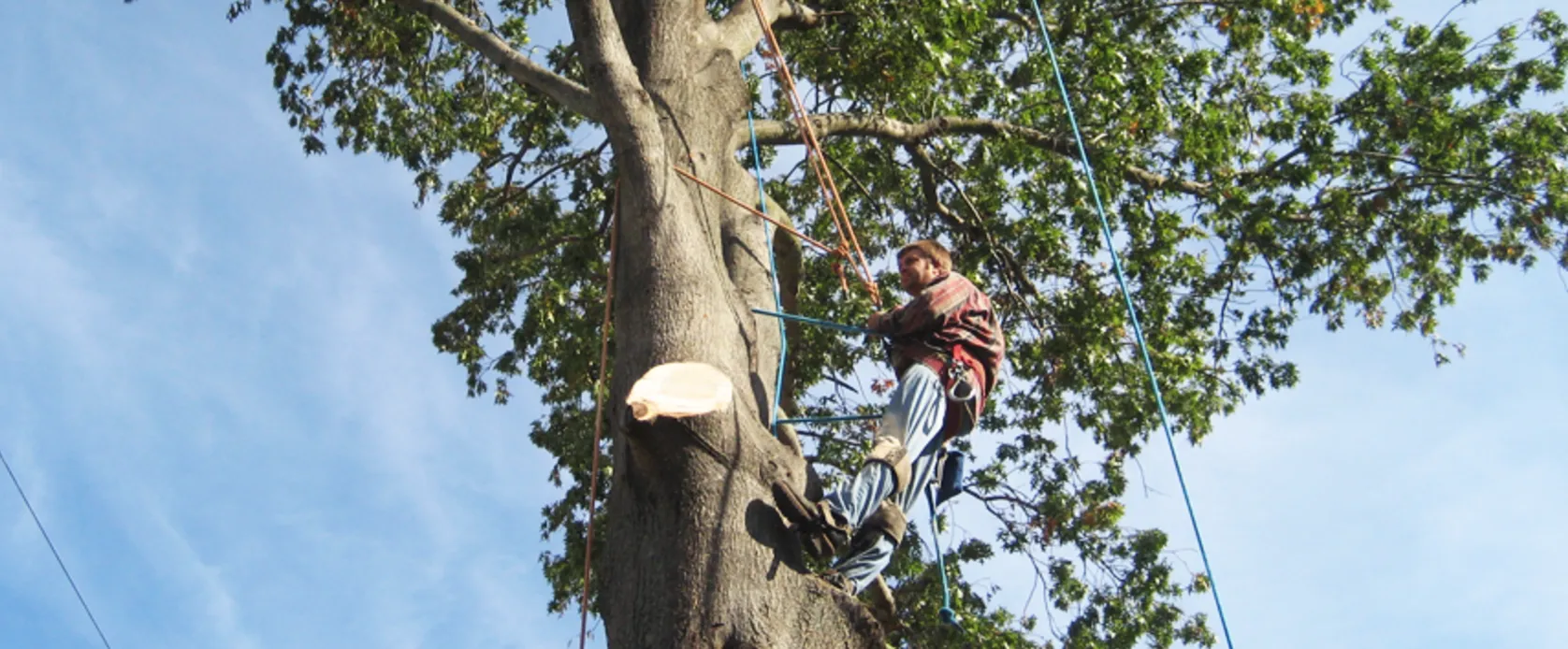
Tree Trimming & Pruning in Spencer
Professional pruning for Spencer and Owen County — managing dense hardwood canopy on large rural properties and in-town lots alike.
$20 OFF Your Service
Submit the form to claim your discount. Mention this offer when we call to confirm your estimate. Valid for all Spencer properties.
The Fastest Way to Get Your Quote
Submit the form and we'll dispatch an estimator to your Spencer property — that's our promise.
It's easier for everyone. We might be up in your neighbor's tree. The form gets us your info so we can schedule your estimate right away.
Prefer to call? We're here at (812) 432-2013
Get Your Quote in 24 Hours
Fill this out and we'll send an estimator to your Spencer property.
Tree Trimming Challenges on Spencer's Large Rural Properties
Spencer sits along the West Fork of the White River about 20 miles southwest of Bloomington, surrounded by some of the densest hardwood forest in west-central Indiana. Owen County properties are typically much larger than suburban lots in Monroe County, and many have 20, 30, or even 50 or more mature trees on a single parcel. That kind of tree density creates pruning demands you simply do not encounter on a half-acre city lot.
On a large wooded property near Spencer, pruning priorities are driven by risk rather than aesthetics. The trees that matter most are the ones closest to your house, garage, barn, driveway, and utility service. A white oak growing in the middle of a 10-acre woodlot can be left alone. A white oak growing 15 feet from your bedroom window with a dead limb the size of your leg cannot. Our approach on Spencer properties starts with a walk-through that identifies every tree within striking distance of a structure, driveway, or high-traffic area, then prioritizes pruning work based on actual risk.
The species growing in Owen County are big trees. White oak, red oak, tulip poplar, and shagbark hickory routinely reach 80 to 100 feet in height with trunk diameters of 24 to 36 inches or more. Pruning at that scale requires aerial access — either by climbing or by bucket truck where terrain allows — and rigging systems that control the weight of large limbs being removed from the canopy. This is not the kind of work that a homeowner with a pole saw should be attempting. A single red oak limb 8 inches in diameter and 15 feet long weighs several hundred pounds. Controlling that weight during removal prevents it from stripping bark down the trunk, damaging the roof below, or injuring someone on the ground.
Owen-Putnam State Forest borders Spencer to the west, and the same mixed-hardwood forest type that defines the state forest extends directly into the residential properties surrounding town. Black walnut is notably common here and presents a unique consideration: walnut produces juglone, a chemical that is toxic to many ornamental plants, and walnut trees near gardens or landscaping sometimes need crown reduction or removal to manage the juglone zone. Before cutting, we discuss whether pruning can solve the problem or whether the walnut's proximity makes removal the better long-term decision.
Hardwood Pruning for Spencer and Owen County Properties
The hardwood species dominating Spencer's landscape each present distinct pruning requirements. Understanding those differences is what separates professional arboriculture from someone with a chainsaw and a ladder.
White oak is the signature species of Owen County's forests and residential landscapes. These trees are long-lived — often exceeding 200 years — and develop massive spreading crowns that can span 80 feet or more at maturity. White oaks need relatively little pruning once they reach mature form, but they do need deadwood removed regularly and any structural defects addressed before they become failure points. White oak wood is exceptionally strong, but the branch unions on older specimens can develop internal decay that is invisible from the ground. Our arborists assess branch union integrity during every pruning visit and flag any areas of concern.
Red oak grows faster than white oak and tends to develop a more upright crown with tighter branch angles. Those tighter angles are where structural problems originate. Red oak is also the species most vulnerable to oak wilt in Indiana, which makes pruning timing non-negotiable. We do not prune live red oak tissue between April and July under any circumstances. If you have a red oak emergency during that window — a broken limb, storm damage — we will address the immediate hazard and defer any elective pruning cuts to the safe season.
Black walnut requires careful pruning technique. Walnut is a high-value timber species when grown straight and clean, and improper pruning that introduces decay into the trunk can destroy both the tree's structural integrity and its potential timber value. We make only necessary cuts on walnut — deadwood, clearance, and structural corrections — and we make them precisely at the branch collar.
Hickory — both shagbark and pignut — is common throughout Spencer's neighborhoods and rural properties. Hickory produces prolific deadwood as it matures, and those dead branches are brittle, heavy, and prone to falling without warning on calm days. A thorough deadwood cleaning every three to five years is the standard recommendation for mature hickory in this area. Hickory bark is also notably slippery, making it one of the more challenging species for climbing arborists to work in safely.
Tulip poplar grows fast and tall in Owen County's deep woodland soils. It produces weak, narrow branch unions naturally, and without early structural pruning, tulip poplars develop the tall, top-heavy crowns that snap apart in wind and ice events. Structural pruning on young tulip poplars — selecting a dominant leader and removing competing stems before they reach 4 inches in diameter — is one of the best long-term investments a Spencer property owner can make.
Ice Storm Prevention and Canopy Management in Spencer
Owen County takes more ice storm damage than most communities in our service area. The geography is the reason. Spencer sits in the White River valley, and cold air drainage during winter precipitation events channels dense, cold air into the valley floor where freezing rain accumulates on branches far more heavily than it does on the ridgelines above. A storm that deposits a quarter inch of ice on a Bloomington property might deposit a half inch or more in the Spencer valley.
Ice loading on tree branches is a force multiplier. A single inch of ice on a branch roughly doubles its weight. For a large red oak with a 60-foot crown spread, that translates to thousands of additional pounds of load distributed across branch unions, attachment points, and the trunk itself. Branches that are weakened by decay, compromised by included bark at the union, or loaded with deadwood are the first to fail. And when one large limb breaks, it often takes others with it on the way down, creating a cascading failure that can strip one side of the crown completely.
Crown thinning is the most effective pruning strategy for reducing ice damage risk. By selectively removing interior and crossing branches — typically 15 to 20 percent of the live canopy — we reduce the total surface area available for ice to accumulate. The remaining branches carry less load and have more space to flex and shed ice naturally. This is not aggressive pruning. It is targeted, conservative work that preserves the tree's form while reducing its vulnerability to the specific weather hazard Spencer experiences every winter.
Deadwood removal before the winter season is equally important. Dead branches are rigid. They cannot flex under load the way live wood does. They snap and fall, and the weight of accumulated ice accelerates their descent. On Spencer properties where trees overhang rooflines, driveways, or outdoor living areas, a fall deadwood cleaning is a practical, cost-effective step that prevents damage from the storms you know are coming.
We also identify and address co-dominant stems that are likely to split under ice load. A co-dominant union with included bark is the single most common point of catastrophic tree failure in ice storms. Reducing one of the competing leaders through subordination pruning — shortening it relative to the other so that one becomes dominant over time — is a technique that changes the long-term structure of the tree and eliminates the split risk.
Power Line Clearance Pruning in Spencer
Spencer and rural Owen County rely heavily on overhead power line distribution. Many properties are served by lines running through wooded corridors where tree branches grow into or near conductors on a recurring basis. Utility companies perform periodic line clearance, but their approach is typically aggressive — removing everything within a specified radius of the conductor regardless of the impact on tree form or health.
Property owners who want to maintain the health and appearance of trees near utility lines have an alternative. Directional pruning — selectively removing only the portions of the crown that grow toward the conductors while maintaining the tree's natural form on the non-conflict side — keeps trees alive and attractive while establishing clearance that lasts several growing seasons before re-growth reaches the wires again.
We perform directional pruning on trees near secondary service drops — the lines running from the utility pole to your house. For the primary distribution lines on the street side of the pole, clearance work falls under the utility company's jurisdiction and requires coordination with the provider. We can help facilitate that coordination if needed.
On Spencer properties where large trees and overhead lines coexist along long driveway corridors, we sometimes recommend a combination of directional pruning for valuable species like oak and walnut, and removal-and-replacement for fast-growing species like silver maple or box elder that will re-grow into the lines within a few years regardless of pruning approach. Replacing a problem tree near a power line with a species that matures at a height below the conductor elevation solves the conflict permanently.
Your Spencer Tree Trimming Team
Bloomington Tree Service Pros serves Spencer and all of Owen County with ISA-certified arborists who understand the species, terrain, and weather patterns specific to this part of Indiana. We follow ANSI A300 Part 1 pruning standards on every job, from a single-tree deadwood removal to a full-property pruning program on a 20-acre rural lot.
We never top trees. We never apply wound sealant. We make every cut at the branch collar and remove no more than 25 percent of the live canopy in a single visit for mature trees. These are the practices that keep trees healthy, structurally sound, and able to defend themselves against the pests, diseases, and weather events that Owen County throws at them.
Our crews carry full general liability and workers' compensation insurance. We provide free on-site estimates for all Spencer and Owen County properties — residential, agricultural, and commercial. We will walk your property, identify the trees that need attention, explain what work is needed and why, and give you a firm price before any work begins.
If your Spencer property has trees that need professional pruning — whether it is storm preparation before winter, deadwood removal over your driveway, or structural training on young shade trees — call us at (812) 432-2013. We are 25 minutes from Spencer and serve Owen County year-round.
Our Tree Trimming & Pruning Service Includes
- Structural pruning for young trees to establish a dominant leader and balanced scaffold branches
- Crown thinning to improve light penetration and air circulation without over-pruning
- Crown raising to provide clearance over rooflines, driveways, and pedestrian areas
- Deadwood removal — all dead, dying, and broken branches removed from the canopy
- Oak wilt prevention scheduling: oak pruning timed outside the April–July high-risk window
- Species-specific timing for maples, sycamores, tulip poplars, and fruit trees
- Vista pruning to open sightlines while preserving tree health and canopy structure
- Fruit tree renewal pruning to maximize yield and manage size in home orchards
Other Tree Services in Spencer
Need Tree Trimming & Pruning in Spencer?
Fill out the form at the top of this page to claim your $20 discount and get a free on-site estimate from our ISA-certified team.