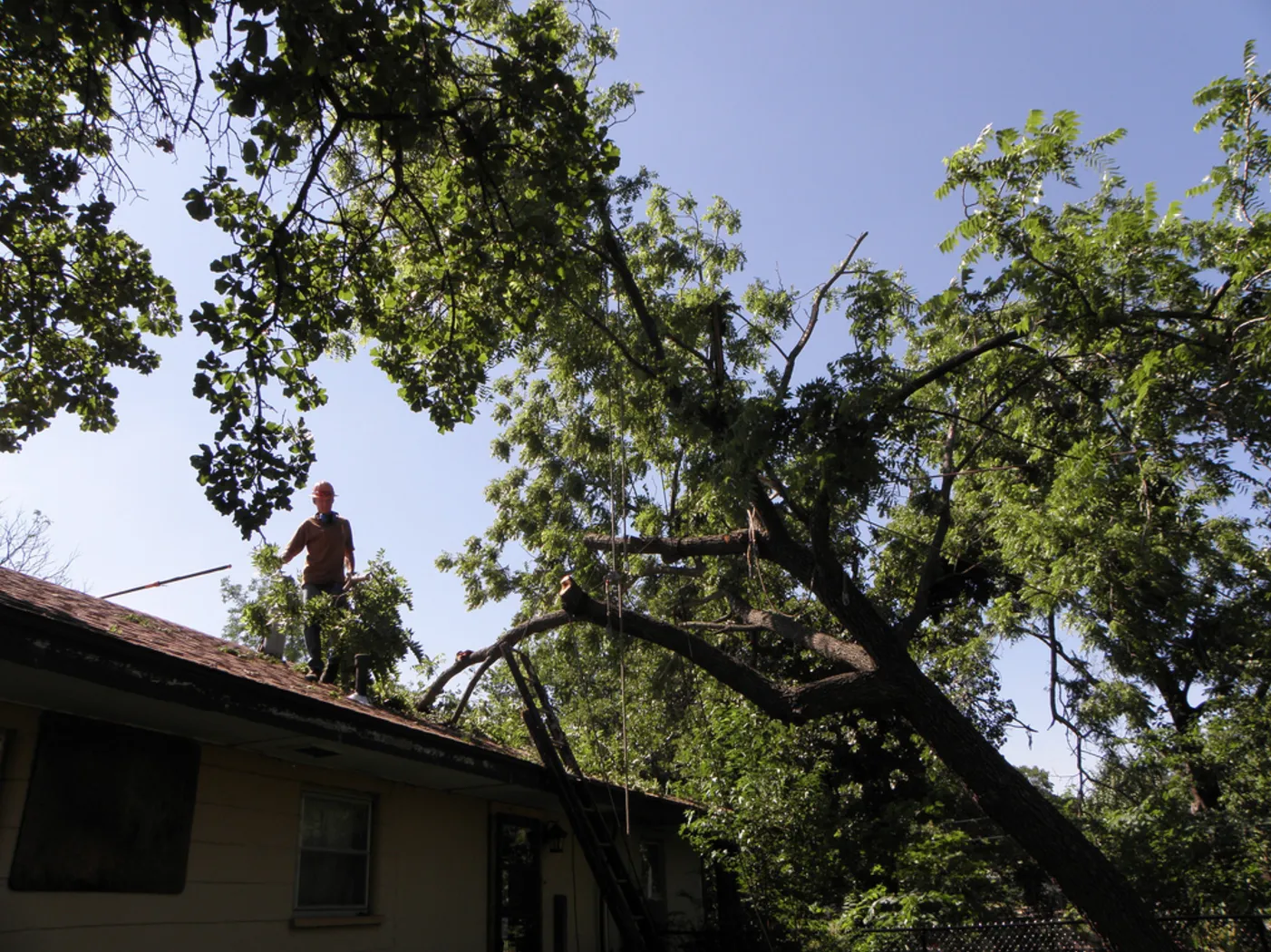
Emergency Storm Service in Bedford
Bedford's shallow bedrock means trees uproot faster and harder during storms. Our ISA-certified crews respond in 30 minutes with the equipment to handle it.
$20 OFF Your Service
Submit the form to claim your discount. Mention this offer when we call to confirm your estimate. Valid for all Bedford properties.
The Fastest Way to Get Your Quote
Submit the form and we'll dispatch an estimator to your Bedford property — that's our promise.
It's easier for everyone. We might be up in your neighbor's tree. The form gets us your info so we can schedule your estimate right away.
Prefer to call? We're here at (812) 432-2013
Get Your Quote in 24 Hours
Fill this out and we'll send an estimator to your Bedford property.
Bedford's Geology Creates a Unique Storm Danger
Bedford sits on top of Lawrence County's famous limestone belt. The same Salem Limestone that built the Empire State Building and the Pentagon lies just inches to a few feet beneath the soil surface across much of Bedford and its surrounding neighborhoods. This geology is the city's claim to fame — and the reason its trees are dangerously vulnerable to storm winds.
Trees need deep root systems to anchor against wind loading. When roots encounter solid limestone bedrock at shallow depth, they spread laterally instead of driving downward. The result is a root system that acts more like a shallow plate than a deep anchor. During severe thunderstorms — which hit Lawrence County regularly from April through September — these shallow-rooted trees uproot with far less wind force than the same species would require in deep-soil areas.
The uprooting pattern in Bedford is distinctive. Instead of snapping at the trunk or losing major limbs, Bedford trees often go over entirely. The root plate lifts out of the thin soil layer, pulling a disc of limestone fragments, soil, and pavement with it. A mature oak or maple uprooting in Bedford does not just damage whatever it falls on — it destroys the root zone, heaves sidewalks and driveways, and leaves a crater that can be six feet deep and twelve feet across.
Bedford's historic neighborhoods compound this risk. The downtown residential areas along 16th Street, R Street, and the neighborhoods surrounding the courthouse are lined with mature hardwoods that were planted 60 to 100 years ago. These trees have reached full canopy size, which means maximum wind exposure, while their root systems remain constrained by the same shallow bedrock that has always been there. These are the trees that produce Bedford's most dramatic storm failures.
The Spring Mill State Park area south of Bedford presents additional challenges. Properties along SR-60 and SR-37 near the park sit among dense forest with mature tulip poplars, oaks, and beeches. When storms tear through this canopy, the debris field can be massive, with trees blocking roads in multiple locations simultaneously.
How Our Bedford Emergency Response Works
Bedford is approximately 25 miles south of our Bloomington base via SR-37. Under normal conditions, our crew reaches Bedford properties in roughly 30 minutes. During active severe weather, we pre-position equipment south of Bloomington when storm forecasts indicate Lawrence County will be impacted, which can reduce that response time significantly.
When you call our 24/7 live dispatcher, we prioritize your call based on the nature of the emergency. A tree on a structure with occupants inside receives our highest priority. A tree blocking a driveway for a household with medical needs is our second tier. Hazardous limbs threatening to fall, trees on vehicles, and general debris follow. This triage system ensures that the most dangerous situations receive attention first during multi-call storm events.
Our Bedford deployments include a crane truck whenever possible, because Bedford's uprooted trees often require crane-assisted removal. A tree that has fallen against a house while still attached to its root plate is under enormous tension. The root ball wants to settle back into the ground, pulling the trunk and crown tighter against the structure. Cutting a tree under this kind of tension without crane support risks uncontrolled movement that can push through walls or collapse roof sections. Our crane operator holds the tree's weight while our cutting crew makes controlled relief cuts.
For Bedford properties with limited access — narrow lots between older homes, rear structures accessed through alleys — we deploy our rigging team with ropes and pulleys to disassemble trees in sections. Each section is lowered on a controlled line to a designated landing zone. This method is slower but prevents the kind of secondary damage that occurs when heavy limbs are allowed to swing or drop freely.
We begin documentation the moment we arrive. Every Bedford emergency response generates a timestamped photo set that records the initial damage, the tree's species and size, the failure point characteristics, the removal process, and the cleared site. This documentation is built for insurance adjusters and has been field-tested with every major carrier operating in Lawrence County.
Severe Storm Scenarios Bedford Homeowners Face
Bedford's storm season runs hard from April through September. Lawrence County sits in a corridor that receives some of the highest severe thunderstorm frequency in south-central Indiana. The National Weather Service issues severe thunderstorm warnings for Lawrence County dozens of times each storm season, and several of those storms produce damaging winds, large hail, or both.
The most common emergency scenario we respond to in Bedford is a whole-tree uprooting onto a residential structure. As described above, Bedford's shallow bedrock makes complete uprooting far more likely than trunk or limb failure. When a 60-foot oak with a root plate constrained to 18 inches of soil topples during a thunderstorm, the entire tree — trunk, crown, and root ball — comes down as a single unit. The impact on a house is devastating. We have responded to Bedford homes where an uprooted tree punched through the roof, collapsed a bearing wall, and shifted the foundation — all from a single tree.
Driveway and road blockage in Bedford often involves the root ball as well as the fallen trunk. Clearing a standard fallen tree from a roadway is straightforward sawing and debris removal. Clearing an uprooted Bedford tree means dealing with a root ball that can weigh several tons and is entangled with chunks of limestone, soil, and sometimes utility infrastructure. Equipment is not optional for these removals.
Trees on vehicles are a frequent Bedford call during hail-producing thunderstorms. Large hail weakens limb attachments, and the wind that follows breaks those weakened limbs free. Parking areas shaded by mature trees — a desirable feature 364 days a year — become damage zones during severe storms.
Multiple simultaneous failures are common during Bedford's strongest storms. A single severe thunderstorm can produce three, four, or five tree failures on a single street in Bedford's older neighborhoods. When this happens, the street becomes impassable and multiple homes are damaged. We coordinate with Bedford's public works department during these events to prioritize road clearance for emergency vehicle access while simultaneously dispatching crews to the most severely damaged homes.
Spring storms following wet winters are the worst combination for Bedford. Extended soil saturation reduces what little root anchorage shallow-bedrock trees have. When the first strong thunderstorm of spring rolls through, the failure rate spikes. We have responded to single-night events in Bedford that produced more tree failures than an entire normal storm season.
Navigating Insurance Claims in Bedford After Storm Damage
Bedford storm damage claims present a specific challenge that homeowners should understand before filing. Because Bedford's tree failures are predominantly whole-tree uprootings rather than limb failures, the damage footprint is larger, the cleanup is more involved, and the costs are higher. Insurance carriers know this, and adjusters assigned to Lawrence County claims generally expect detailed documentation.
Our documentation protocol addresses this expectation directly. For every Bedford emergency response, we photograph the failure mechanism — specifically the root plate and the depth of soil over bedrock. This evidence establishes that the tree failed due to storm forces acting on a naturally constrained root system, not due to disease, neglect, or pre-existing instability. This distinction matters because some policies exclude coverage for tree failures attributed to poor maintenance.
We photograph the tree species, estimate the diameter at breast height, and document the canopy spread. This information allows adjusters to calculate the reasonable cost of removal based on standardized industry metrics. When our invoice aligns with what the adjuster calculates independently, the claim moves faster.
For Bedford properties where the uprooting has damaged hardscape — sidewalks, driveways, retaining walls, patios — we document that damage separately with measurements and photographs. Hardscape damage is often covered under a different provision of the homeowner's policy than the tree removal itself, and separating the documentation prevents these costs from being overlooked.
We have extensive experience with State Farm, Allstate, Indiana Farm Bureau, and Nationwide on Lawrence County claims. Indiana Farm Bureau insures a significant portion of Bedford properties, and their claims process has specific documentation preferences that we have refined over years of working with their adjusters.
For properties near Spring Mill State Park or in the rural areas of Lawrence County, we also document any road blockage our crew had to clear to access the property. Depending on your policy, the cost of clearing access may be reimbursable as a necessary component of the emergency response.
Bedford Storm Damage — Call Us Right Now
Bedford's shallow bedrock makes every storm more dangerous for your property than it would be anywhere else in our service area. When a tree goes over in Bedford, it goes over completely — root ball and all — and the resulting damage to structures, driveways, and utilities is severe.
Bloomington Tree Service Pros provides 24/7/365 emergency storm response to Bedford and Lawrence County. We are ISA-certified arborists carrying full general liability and workers' compensation insurance. We arrive with crane trucks, rigging equipment, structural tarps, and the documentation expertise to support your insurance claim from first contact through final settlement.
Do not try to cut a tensioned, uprooted tree yourself. The forces stored in a partially fallen tree attached to its root plate are enormous and invisible. One wrong cut can send tons of wood in an unexpected direction. This is work that requires professional equipment and ISA-level training.
Our live dispatcher answers every call, every hour, every day. Call (812) 432-2013 and our crew will be in Bedford within 30 minutes.
Our Emergency Storm Service Service Includes
- 24/7/365 live dispatcher — real crew response, not a voicemail, for every emergency call
- Rapid response to all Monroe County communities including Bloomington, Ellettsville, and Stinesville
- Structural tarping of roof breaches to prevent water intrusion while repairs are arranged
- Complete documentation of all storm damage with timestamped photos for insurance claims
- Hazardous limb removal from structures using rigging systems that prevent secondary damage
- Driveway and road clearance for blocked access — priority response for medical necessity situations
- Coordination with Duke Energy and Indiana utility providers for tree-on-wire situations
- Insurance carrier communication and direct adjuster coordination upon request
Other Tree Services in Bedford
Need Emergency Storm Service in Bedford?
Fill out the form at the top of this page to claim your $20 discount and get a free on-site estimate from our ISA-certified team.