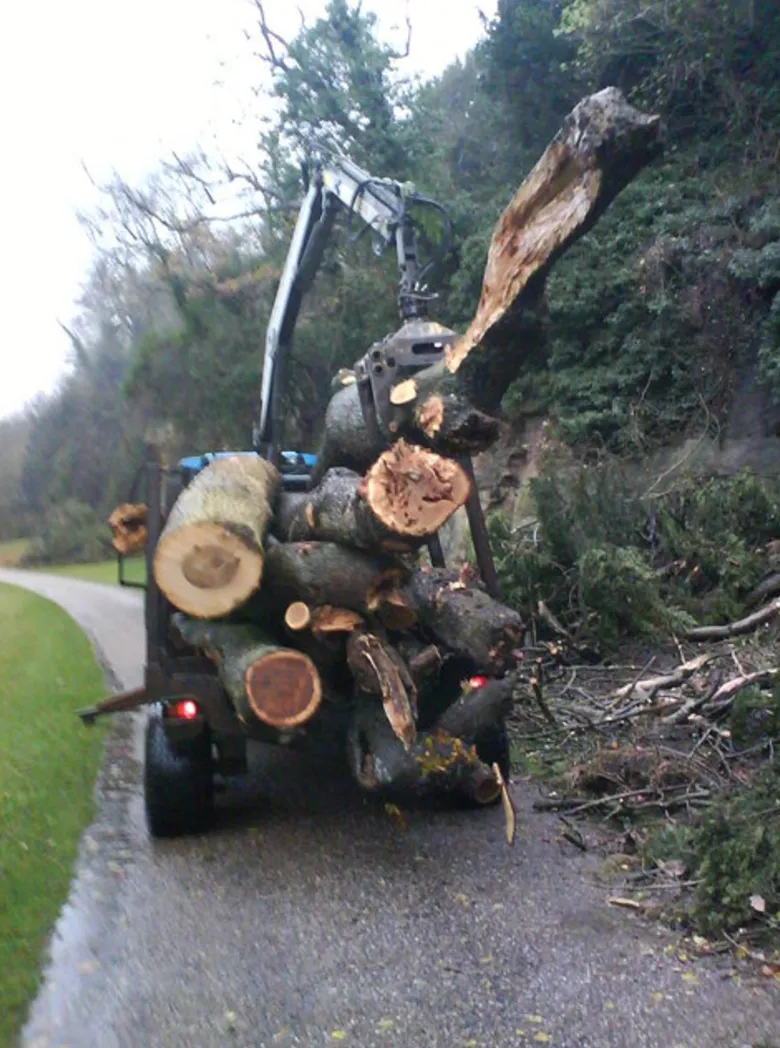
Land Clearing in Nashville
Specialized hillside clearing and selective timber management for Nashville and Brown County — where steep terrain and forest character demand expert care.
$20 OFF Your Service
Submit the form to claim your discount. Mention this offer when we call to confirm your estimate. Valid for all Nashville properties.
The Fastest Way to Get Your Quote
Submit the form and we'll dispatch an estimator to your Nashville property — that's our promise.
It's easier for everyone. We might be up in your neighbor's tree. The form gets us your info so we can schedule your estimate right away.
Prefer to call? We're here at (812) 432-2013
Get Your Quote in 24 Hours
Fill this out and we'll send an estimator to your Nashville property.
Why Nashville and Brown County Require Specialized Land Clearing
Brown County is not like anywhere else in our service area. The terrain is relentlessly hilly — steep ravines, narrow ridgetops, and slopes that can exceed thirty percent grade. There is almost no flat ground. Every building site in the Nashville area is either carved into a hillside, perched on a ridge, or tucked into a narrow hollow. This makes land clearing here fundamentally different from work on the rolling terrain of Monroe or Morgan County.
Brown County's identity is its forest. The dense hardwood canopy that blankets these hills draws visitors, artists, and homebuyers who value the natural landscape above almost everything else. Clear-cutting a lot in Brown County is not just environmentally problematic — it is culturally unacceptable. Property owners here expect selective clearing that preserves the forest character while creating a functional building site. That expectation raises the bar for every clearing contractor working in the area.
Bloomington Tree Service Pros has the equipment, training, and environmental sensitivity to handle Brown County's demanding conditions. We are about 30 minutes west of Nashville and we have cleared building sites throughout the county — from the ridges above Bean Blossom to the slopes south of town. Our approach prioritizes minimal disturbance, maximum preservation, and rigorous erosion control on every project.
Clearing on Steep Slopes and Limited-Access Sites
Equipment access is often the single biggest challenge on Nashville-area clearing projects. Many properties are reached by narrow, winding gravel roads that were never designed for heavy trucks and tracked machines. Some building sites can only be accessed by crossing a seasonal creek or climbing a grade that standard equipment cannot handle. Planning the access route is sometimes as complex as planning the clearing itself.
On steep slopes, conventional clearing methods — pushing trees downhill with a bulldozer — create massive erosion problems and destroy everything in the path. We use a different approach. Our tracked forestry mulcher can operate on slopes up to about thirty-five degrees, grinding brush and small trees in place without disturbing the soil surface. For larger trees, we use directional felling to drop trees uphill or across the slope, then process them where they fall using our chipper and cut-to-length methods.
Crane-assisted removal is sometimes necessary on the steepest sites, particularly when large trees need to come down near an existing structure or within a tight building envelope. We set the crane on the most stable ground available and lift sections out vertically, avoiding the slide-and-tumble damage that felling causes on steep terrain.
Every piece of equipment we use in Brown County is selected for its ability to work on slopes without causing unnecessary ground disturbance. Tracked machines distribute weight more evenly than wheeled equipment, and our operators are experienced in hillside work. Even so, we limit equipment movement to defined paths and avoid working on saturated soils when rain has softened the ground.
Selective Clearing to Preserve Brown County's Forest Character
In Brown County, the clearing plan is as much about what stays as what goes. A well-executed selective clearing project creates a building site, driveway, and utility corridor while leaving the surrounding forest intact and healthy. Done poorly, selective clearing can damage retained trees, open the canopy to wind throw, and create an unnatural appearance that takes years to recover.
Our ISA-certified arborists lead the planning process on every Nashville-area project. We start by mapping every significant tree on the site — species, diameter, height, crown spread, health condition, and structural integrity. We then overlay the proposed building footprint, driveway alignment, septic system location, and utility routes to determine exactly which trees must be removed and which can be preserved.
The goal is to remove only what is necessary. We look for natural openings in the canopy where a building pad can be located with minimal removal. We route driveways to follow the contour of the slope rather than cutting straight uphill, which reduces both tree removal and erosion. Septic fields are positioned to avoid root zones of valuable trees whenever the soil conditions and regulations allow.
Preserved trees in Brown County are predominantly oak, hickory, beech, tulip poplar, and sugar maple. These species respond differently to the sudden exposure that comes when neighboring trees are removed. Some, like beech, are prone to sunscald on newly exposed bark. Others, like tulip poplar, can lean toward the new light opening and become structurally compromised over time. We account for these species-specific responses in our preservation decisions, sometimes recommending the removal of a borderline tree now rather than dealing with its failure later.
Erosion Control on Brown County Hillsides
Erosion control is not optional in Brown County — it is the most important aspect of any clearing project on steep terrain. The thin, erodible soils on Brown County slopes can wash away quickly once vegetation is removed. A single heavy rain on an unprotected cleared hillside can send tons of sediment downslope, burying driveways, filling culverts, and degrading the streams that feed Lake Monroe and the broader watershed.
Our erosion control strategy for Nashville-area projects goes well beyond minimum regulatory requirements. We install erosion controls before clearing begins, not after. Silt fencing goes in along all downhill perimeters. On steeper slopes, we add fiber rolls and erosion blankets on exposed soil immediately after clearing. We avoid clearing during the wettest months when possible, and we stage the work to minimize the amount of bare ground exposed at any one time.
Forestry mulching is a significant erosion control advantage on hillside sites. When the mulcher grinds brush and small trees, the resulting mulch layer stays in place on the ground surface. This layer acts as instant erosion protection — it absorbs rainfall impact, slows surface runoff, and holds the soil in place while permanent vegetation establishes. On sites where we can use forestry mulching for the majority of the clearing, erosion risk drops dramatically compared to conventional clearing methods.
After clearing, we seed all disturbed areas with a temporary erosion control mix appropriate for the season. In spring and summer, that is a fast-germinating grass blend. In fall and winter, we use cereal rye or wheat that germinates at lower temperatures. The goal is to get a vegetative cover established within two to three weeks of clearing to lock the soil in place before heavy rains arrive.
Plan Your Nashville Building Site Clearing Project
Building in Brown County is a deliberate choice — you are choosing the forest, the hills, and the character that makes this place special. Your land clearing contractor should respect that choice and bring the skill to execute it without unnecessary damage.
Bloomington Tree Service Pros starts every Nashville-area project with an extended site walk. On steep, wooded properties, this walk can take two to three hours as we map trees, assess slopes, evaluate soil conditions, and identify the best access routes. This upfront investment in planning prevents costly mistakes during execution.
Our proposal for Brown County projects includes a detailed clearing plan showing exactly which trees will be removed, which will be preserved, where equipment will operate, and how erosion will be controlled throughout the process. We include photos and GPS coordinates of significant trees so there is no ambiguity on clearing day.
We understand that Brown County building projects often involve custom homes with complex site plans and extended construction timelines. We coordinate with your architect, builder, and septic installer to sequence the clearing work so it supports the overall project schedule. If your building site needs to sit through a winter before construction begins, we ensure it is stabilized and protected until the builder is ready.
Bloomington Tree Service Pros is fully insured and our arborists hold ISA certification. We have the specialized hillside equipment — tracked mulchers, cranes, compact excavators — that Brown County terrain demands.
Call (812) 432-2013 to schedule your site evaluation. We will walk your property, discuss your vision, and develop a clearing plan that creates your building site while preserving the forest setting you chose Brown County for.
Our Land Clearing Service Includes
- Full lot clearing and grubbing including stump and root system removal to finished grade
- Selective clearing to preserve high-value timber trees, mature hardwoods, or natural buffers
- Forestry mulching for efficient brush and small-diameter tree removal without burn piles
- Invasive species removal — autumn olive, multiflora rose, bush honeysuckle, and callery pear
- Site preparation for building pads, driveways, septic systems, and utility corridors
- Monroe County and City of Bloomington permit coordination for clearing near waterways and floodplains
- Debris hauling and recycling — green waste diverted from landfill where markets exist
- Erosion control and temporary stabilization measures after clearing to meet county standards
Other Tree Services in Nashville
Need Land Clearing in Nashville?
Fill out the form at the top of this page to claim your $20 discount and get a free on-site estimate from our ISA-certified team.