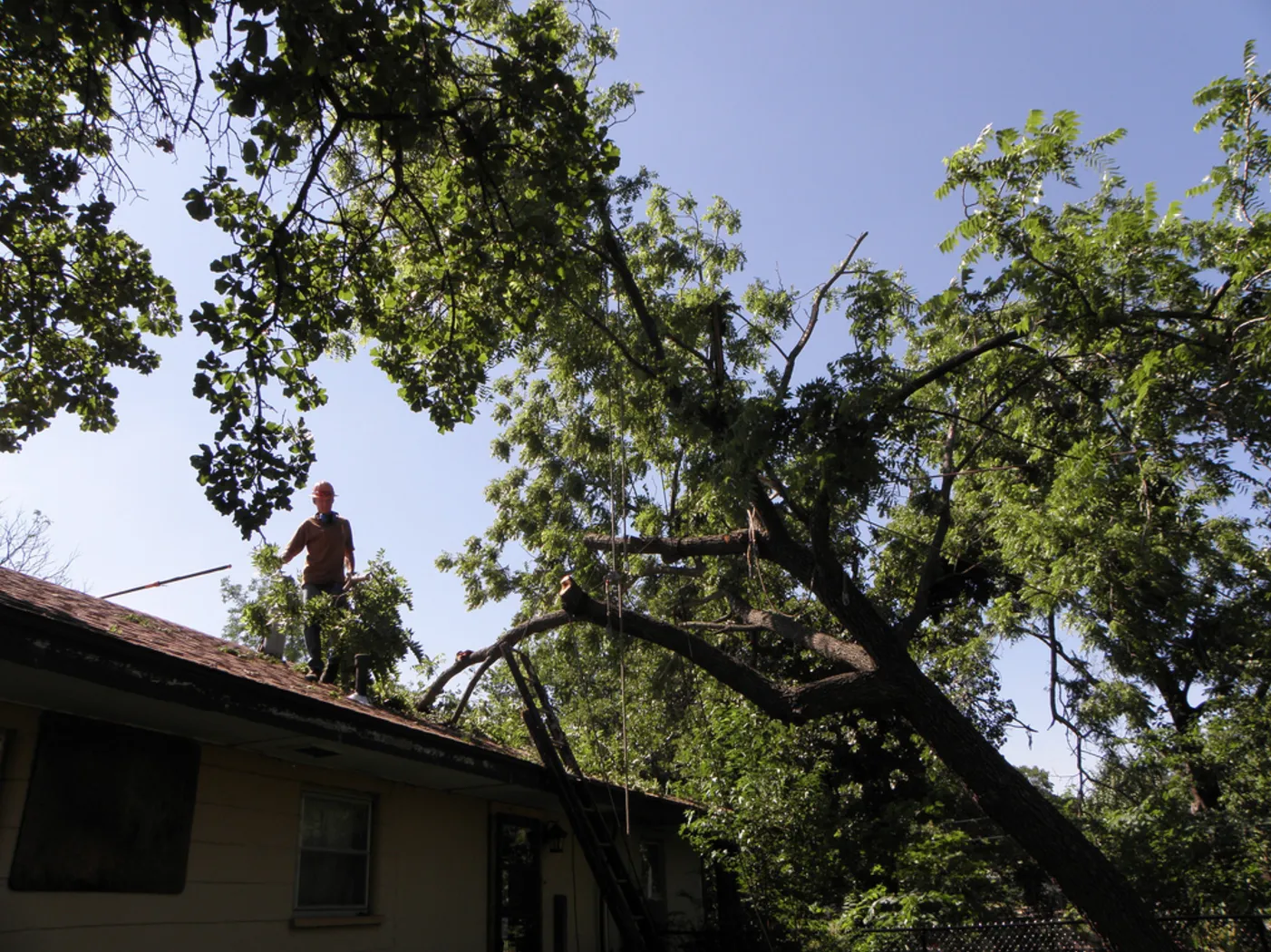
Emergency Storm Service in Nashville
Brown County's steep terrain and dense forest make emergency tree work here the most challenging in our service area. We are built for it.
$20 OFF Your Service
Submit the form to claim your discount. Mention this offer when we call to confirm your estimate. Valid for all Nashville properties.
The Fastest Way to Get Your Quote
Submit the form and we'll dispatch an estimator to your Nashville property — that's our promise.
It's easier for everyone. We might be up in your neighbor's tree. The form gets us your info so we can schedule your estimate right away.
Prefer to call? We're here at (812) 432-2013
Get Your Quote in 24 Hours
Fill this out and we'll send an estimator to your Nashville property.
Nashville's Terrain Makes Every Storm Emergency Harder
Nashville and Brown County present the most difficult emergency tree service conditions in south-central Indiana. This is not a flat suburban landscape with wide streets and easy equipment access. Brown County is defined by steep, forested ridges separated by narrow valleys. Roads twist along hillsides. Driveways climb at grades that would challenge a four-wheel-drive truck in good weather. And the forest that makes Brown County beautiful is the same forest that turns every storm into a cascading emergency.
The density of Brown County's forest canopy creates a phenomenon called cascading failure during storms. When one large tree falls, it strikes adjacent trees that are growing in close proximity. Those trees, already stressed by the storm's wind loading, absorb the additional impact force and fail as well. A single initial failure can trigger a chain reaction that brings down three, four, or five trees along a hillside. The resulting debris field is massive, tangled, and extremely difficult to clear.
Nashville's topography channels wind in unpredictable ways. Ridgetop properties experience wind speeds significantly higher than valley locations during the same storm. Trees on exposed ridgelines — especially those on the south and west faces that bear the brunt of prevailing storm winds — endure forces that valley-floor trees never encounter. But valley properties are not safe either. Storm downdrafts compress and accelerate as they funnel through Brown County's narrow valleys, producing localized wind gusts that can exceed the general storm wind speeds.
Access to Nashville properties is the single greatest challenge during storm emergencies. Many properties are served by a single road or driveway. There is no alternate route. When a tree falls across that sole access, the property is isolated. We have responded to Nashville emergencies where the property owner could not leave and emergency vehicles could not enter. In these situations, clearing the access route is the first and most urgent task — it takes priority over everything else.
Brown County also has a large number of vacation homes, rental cabins, and seasonal properties. During storms, these properties may have no one present to report damage. Trees can fall on a structure, breach the roof, and allow water damage to progress for days before anyone discovers it. If you own property in Brown County and receive severe weather alerts, call us to arrange a post-storm inspection even if you cannot check the property yourself.
How We Respond to Nashville Emergencies
Nashville is approximately 20 miles east of Bloomington. Our response time to Nashville properties is roughly 30 minutes, though terrain and road conditions within Brown County can add time once we leave SR-46 and enter the county road and private drive network.
Our Nashville emergency deployments are configured specifically for Brown County terrain. We bring smaller, more maneuverable equipment that can navigate steep grades and tight turns. Our standard crane truck is not always viable on Nashville driveways — many are too steep, too narrow, or surfaced with gravel that cannot support the outrigger loads. For these properties, we rely on our technical rigging team, which can remove trees of any size using ropes, pulleys, and mechanical advantage systems that do not require a crane.
When you call our live dispatcher about a Nashville emergency, the first questions focus on access. Can you leave your property? Can vehicles reach your driveway entrance? Is the road to your property passable? These answers determine our approach. If the property is accessible, we deploy directly. If access is blocked, we deploy with additional equipment and crew specifically to cut a path in.
Our Nashville response begins with a systematic assessment from the access point inward. We evaluate every tree along the driveway and road for storm damage, lean, and residual risk. Clearing one fallen tree only to have another damaged tree fall on our crew or equipment an hour later is a risk we actively manage. We mark and address hazard trees along the entire approach path, not just the one that is currently blocking access.
For properties with cascading failures — multiple trees down in an overlapping debris field — we work methodically from the outside in. Each tree in the tangle is analyzed for tension, compression, and lean before any cuts are made. Cutting into a tangled debris field without understanding the forces at play is one of the most dangerous actions in arboriculture. Our crew treats every cut as a load-bearing decision.
We carry satellite communication equipment for Nashville deployments because cellular coverage in Brown County's valleys is unreliable. If our crew cannot reach our dispatcher by phone, they communicate via satellite to ensure we can coordinate additional resources if the situation escalates beyond the initial crew's capacity.
Brown County's Most Dangerous Storm Scenarios
The emergency scenarios that play out in Nashville and Brown County are shaped by the terrain, the forest density, and the isolation of individual properties. These factors combine to create situations that are genuinely dangerous — not just inconvenient.
Property isolation from a single fallen tree is the most common Nashville emergency. A homeowner calls because a tree has fallen across their only driveway or access road. They cannot leave. Emergency vehicles cannot enter. If the homeowner has a medical condition, requires regular medication, or if someone is injured, the situation escalates from property damage to a life-safety issue. We treat every access blockage in Brown County as a potential medical emergency until confirmed otherwise.
Cascading tree failures on steep hillsides above structures are the most dangerous scenario our crews face in Brown County. Multiple trees have failed on the slope above a house. Some are leaning against others. Some are suspended in the canopy of standing trees. Some have landed on or near the structure. The entire hillside is a loaded spring of unpredictable stored energy. Working beneath a hillside with multiple failed and partially failed trees requires constant overhead awareness, escape route planning, and a crew that understands that every cut changes the force dynamics of the entire debris field.
Trees falling across public roads in Brown County can strand entire neighborhoods. SR-135 through Nashville and SR-46 approaching from the west pass through heavy forest cover. When multiple trees fall across these state roads during a storm, the communities beyond the blockages are cut off. We coordinate with Brown County Highway Department and INDOT during these events to prioritize road clearance while also responding to private property emergencies.
Roof breaches in Nashville are especially damaging because of the terrain. Many Nashville homes are built into hillsides, which means water from a roof breach does not just drip into an attic — it flows downhill through the structure, following the grade. A roof breach on the uphill side of a Nashville home can produce water damage throughout the entire structure within hours. Our structural tarping is the first priority once the tree is stabilized, specifically to stop water infiltration before it migrates through the building.
Vacation and rental properties with undetected damage represent a slow-burning emergency. A tree falls on a cabin during a Wednesday night storm. The next renters arrive on Friday afternoon. The tree has been on the structure for 40 hours. Water has been entering the building. Mold conditions are developing in insulation and drywall. Structural members may be compromised. What started as a tree problem is now a restoration project. Early detection and response prevent this escalation.
Insurance and Documentation for Brown County Storm Damage
Brown County storm damage claims have a characteristic that distinguishes them from claims in our other service areas: the access component. When a tree blocks the only route to a property, clearing that tree is a necessary precondition for any other emergency work. This access-clearance cost is typically reimbursable under your homeowner's policy, but only if it is documented as a distinct line item with supporting photographs.
Our documentation protocol for Nashville emergencies captures the access condition at the time of arrival. If we had to cut through one or more trees to reach the primary damage site, each access-clearance tree is documented separately with photographs showing its position across the road or driveway, the species and size, and the cleared path after removal. This establishes that access clearance was a necessary emergency expense, not elective work.
For the primary damage — tree on structure, tree on vehicle, hazardous leaners threatening a building — we follow our standard documentation protocol. Timestamped photographs of all damage, the tree's failure mechanism, the species and size, and the completed removal. For cascading failures, each tree is documented individually because policy limits on tree removal are often per-tree.
Brown County vacation homes and rental properties add a complication: the property owner may not be present during the emergency response. We can work with property managers, rental agencies, or the owner remotely to obtain authorization for emergency work. Our documentation package is designed to be self-explanatory — the photographs and descriptions tell the full story of the emergency without requiring the property owner to have been present.
We work with all major carriers on Brown County claims, including State Farm, Allstate, Indiana Farm Bureau, and Nationwide. The steep-terrain access costs and cascading-failure complexity typical of Nashville claims mean that our documentation must be thorough enough to justify costs that are higher, on average, than comparable claims in flatter areas. Our documentation meets this standard consistently.
Nashville Storm Emergency — Do Not Wait
Brown County storms create emergencies that escalate faster than anywhere else in our service area. A single fallen tree can isolate your property. A roof breach on a hillside home can flood the entire structure. Cascading failures can leave you surrounded by unstable, partially fallen trees that could release at any moment.
Bloomington Tree Service Pros provides 24/7/365 emergency storm response to Nashville and Brown County. We are ISA-certified arborists with full general liability and workers' compensation insurance. Our crews are specifically trained and equipped for Brown County's steep terrain, narrow access roads, and dense forest conditions.
When a storm hits Brown County, do not assume someone else will handle it. Do not wait to see if the tree shifts further. Do not drive under a hung tree to get to the main road. And if you own a Nashville vacation property and see severe weather in the forecast, call us proactively to arrange a post-storm inspection.
Call (812) 432-2013 now. A live dispatcher answers every call. We will reach your Nashville property within 30 minutes and start solving the problem immediately.
Our Emergency Storm Service Service Includes
- 24/7/365 live dispatcher — real crew response, not a voicemail, for every emergency call
- Rapid response to all Monroe County communities including Bloomington, Ellettsville, and Stinesville
- Structural tarping of roof breaches to prevent water intrusion while repairs are arranged
- Complete documentation of all storm damage with timestamped photos for insurance claims
- Hazardous limb removal from structures using rigging systems that prevent secondary damage
- Driveway and road clearance for blocked access — priority response for medical necessity situations
- Coordination with Duke Energy and Indiana utility providers for tree-on-wire situations
- Insurance carrier communication and direct adjuster coordination upon request
Other Tree Services in Nashville
Need Emergency Storm Service in Nashville?
Fill out the form at the top of this page to claim your $20 discount and get a free on-site estimate from our ISA-certified team.