Emergency Storm Service in Martinsville
Morgan County's tornado risk and White River corridor demand experienced emergency response. Our crews reach Martinsville in 35 minutes.
$20 OFF Your Service
Submit the form to claim your discount. Mention this offer when we call to confirm your estimate. Valid for all Martinsville properties.
The Fastest Way to Get Your Quote
Submit the form and we'll dispatch an estimator to your Martinsville property — that's our promise.
It's easier for everyone. We might be up in your neighbor's tree. The form gets us your info so we can schedule your estimate right away.
Prefer to call? We're here at (812) 432-2013
Get Your Quote in 24 Hours
Fill this out and we'll send an estimator to your Martinsville property.
Martinsville's Storm Profile — Tornadoes, Flooding, and Massive Trees
Martinsville occupies a position in Morgan County that concentrates multiple severe weather threats into a single geography. The city sits along the White River corridor, within the I-69 transportation corridor, and at the southern edge of central Indiana's tornado-active zone. Each of these factors contributes to a storm risk profile that is among the most serious in our service area.
The White River corridor that passes through Martinsville sustains some of the largest trees in Morgan County. Sycamores along the riverbanks reach enormous proportions — trunk diameters of four to five feet are common, with canopy spreads exceeding 80 feet. Cottonwoods of similar scale line the floodplain. These species grow fast, grow large, and have a well-documented tendency to fail catastrophically during storms. Sycamore wood is brittle under torsional wind loading, and large sycamores frequently shed massive limbs or split apart during thunderstorms. A single sycamore limb can weigh several thousand pounds.
Morgan County falls within a tornado watch zone that activates multiple times each storm season. Martinsville has experienced direct tornado impacts historically, and near-misses that produced EF0 to EF1 damage are not uncommon. Tornado damage to trees is categorically different from thunderstorm damage. Tornado winds create twisting forces that snap trunks, uproot entire stands of trees simultaneously, and scatter debris across wide areas. A tornado track through a wooded Martinsville neighborhood can produce dozens of simultaneous tree failures in a matter of seconds.
The I-69 corridor through Martinsville adds commercial property exposure to the equation. Businesses along the highway corridor — hotels, restaurants, retail, and light industrial — face storm damage to parking lot trees, sign structures, and building components. Commercial storm damage requires a different response approach than residential work, with larger equipment, different safety protocols, and distinct insurance documentation requirements.
The Morgan-Monroe State Forest lies southeast of Martinsville, and properties along its boundary experience storm damage amplified by the surrounding dense forest. When storms hit the forest canopy, broken trees and debris fall across private roads, driveways, and onto structures built along the forest edge. The sheer volume of woody debris from a forest storm event can be overwhelming.
Our Martinsville Emergency Response Protocol
Martinsville is approximately 30 miles north of our Bloomington base via I-69 and SR-37. Our standard response time to Martinsville properties is 35 minutes. During confirmed tornado warnings or major storm events, we stage equipment at intermediate positions along the corridor when conditions allow, which can reduce response time for the Martinsville area.
Our 24/7 live dispatcher answers your call and immediately categorizes the emergency. For Martinsville, we pay particular attention to three high-priority indicators: trees on occupied structures, trees on or near power lines in the White River flood zone, and trees blocking I-69 or SR-37 where highway safety is a factor. Each of these scenarios triggers a specific response configuration.
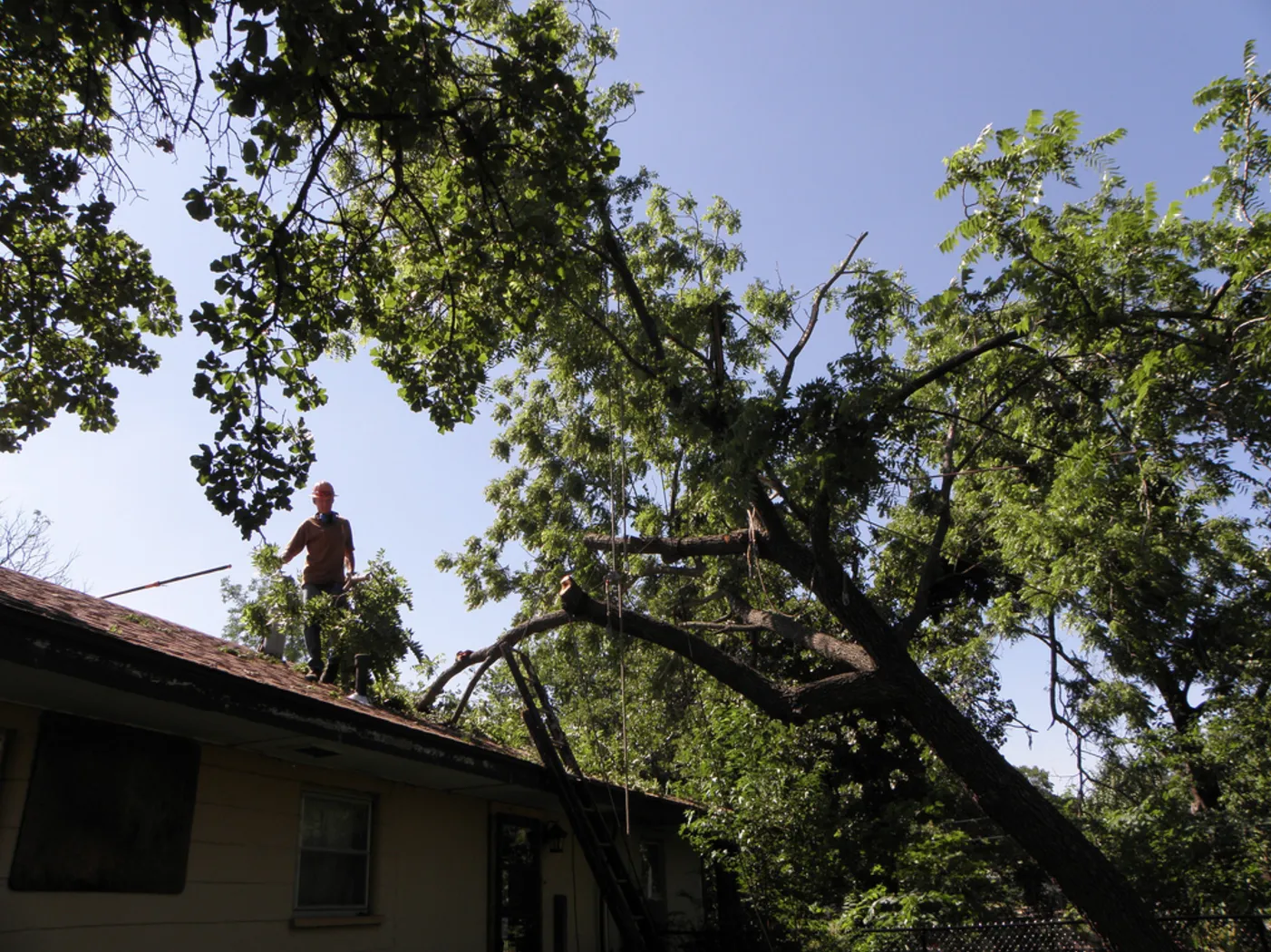
For residential emergencies in Martinsville's established neighborhoods, we deploy our standard emergency package: crane truck, rigging crew, chainsaws, chipper, and structural tarping materials. The crane is especially important in Martinsville because of the large sycamores and cottonwoods. Removing a 48-inch-diameter sycamore from a rooftop without crane support would require cutting the tree into small sections while it rests on the damaged structure — each cut adding risk of further structural collapse. With our crane, we lift major sections clear of the structure before making any cuts.
For commercial properties along the I-69 corridor, we deploy additional traffic control measures and coordinate with Martinsville police if the damage affects public right-of-way. Commercial storm damage often involves multiple trees, parking lot light poles entangled with fallen limbs, and structures with flat roofs that are more susceptible to puncture from falling debris. Our commercial response team includes crew members experienced with these specific challenges.
We coordinate with Duke Energy on every Martinsville call that involves trees near or in contact with power lines. The White River corridor is served by overhead transmission and distribution lines that run through heavy tree cover. During storms, multiple spans can be affected simultaneously, and Duke's prioritization of repairs may not align with your personal emergency timeline. We work within their safety requirements while advocating for rapid de-energization of the specific span affecting your property.
Emergency Scenarios Unique to Martinsville and Morgan County
Martinsville produces emergency scenarios that differ from other cities in our service area due to the combination of massive riverine trees, tornado exposure, and mixed residential-commercial land use.
Sycamore failures along the White River are our most distinctive Martinsville emergency. These trees fail in ways that are hard to predict and hard to manage. A sycamore with a trunk diameter over three feet can shed a limb that is itself larger than most entire trees in a typical suburban yard. When one of these limbs falls on a house, it does not just damage the roof — it can collapse an entire room. The wood is dense and heavy, and the irregular branching pattern means fallen sycamore limbs do not lie flat. They prop up at angles, lean against structures under tension, and create complex forces that require careful analysis before any cutting begins.
Tornado damage in Martinsville, when it occurs, overwhelms normal emergency response capacity. A tornado can snap or uproot 50 trees in a single residential block in under a minute. The debris field includes not just tree material but structural components, vehicles, and utility infrastructure all mixed together. Our tornado damage response protocol shifts from individual tree removal to systematic debris clearance — opening travel corridors first, then addressing individual property damage in priority order.
Flooding along the White River undercuts tree stability on Martinsville properties near the river corridor. We see a specific pattern: a property owner calls about a tree that fell during what seemed like a modest storm. On inspection, we find that the tree's root zone was severely eroded by recent flooding, leaving the tree standing on a fraction of its original root support. These flood-weakened trees fail at much lower wind speeds than healthy trees, and the failure is often a complete uprooting with the root ball pulling free of the waterlogged soil.
Commercial property damage along the I-69 corridor frequently involves trees falling across parking lots and striking multiple vehicles. A restaurant or hotel with a large shade tree in the parking area can suffer simultaneous damage to the building, several vehicles, the parking surface, and underground utilities if the root plate lifts. These multi-component damage events require meticulous documentation because multiple insurance policies — commercial property, auto, and potentially general liability — may be involved.
Trees falling across roads in the Morgan-Monroe State Forest area can isolate rural properties for extended periods. The forest's dense canopy means a single storm can drop trees across a road in multiple locations over a stretch of several miles. Clearing a path requires working from the public road inward, which is time-consuming and equipment-intensive.
Storm Damage Insurance Documentation for Martinsville Properties
Martinsville's mix of residential and commercial properties means our insurance documentation must serve different types of policies and different types of adjusters. We have refined our documentation process to handle both.
For residential claims in Martinsville, our standard documentation package includes timestamped photographs of all damage, identification of the tree species and size, documentation of the failure mechanism, and photographs of the cleared site. For properties near the White River, we also document any evidence of flood-related root zone erosion that contributed to the failure. This information helps establish that the tree failure was a covered peril — storm damage — rather than an excluded cause like gradual deterioration.
For commercial claims along the I-69 corridor, our documentation expands to include the full damage footprint. This means photographing not just the tree and the primary structure it struck, but also any vehicles damaged, parking lot surfaces cracked by root ball heaving, light poles displaced, and sign structures compromised. Each element of damage is documented separately with measurements and descriptions because commercial policies typically have different sub-limits for different types of property damage.
We provide detailed invoicing that separates labor categories: emergency tree removal, hazardous limb stabilization, structural tarping, debris removal and hauling, and site restoration. This separation allows adjusters to apply the correct coverage category to each component of the work. Combining all work into a single line item — which some tree services do — creates ambiguity that slows claims processing.
Our experience with Martinsville-area claims spans State Farm, Allstate, Indiana Farm Bureau, Nationwide, and several commercial carriers. Morgan County properties are frequently insured through agents in Martinsville and Mooresville who are familiar with our company and our documentation standards. This familiarity helps accelerate the claims process.
When tornado damage occurs, documentation requirements increase significantly. Tornado damage claims are often larger, involve more complex damage patterns, and may be subject to higher scrutiny. We document the directional pattern of tree failures to establish consistency with the tornado track, which corroborates your claim that the damage resulted from the tornado event rather than pre-existing conditions.
Martinsville Storm Emergency — We Answer Live, 24/7
Martinsville faces more severe weather variety than almost any city in our service area. Tornadoes, straight-line thunderstorm winds, river flooding that weakens root systems, and massive sycamores and cottonwoods that produce dramatic failures — every storm season tests Morgan County properties.
Bloomington Tree Service Pros provides 24/7/365 emergency response to Martinsville with a 35-minute response time. We are ISA-certified, fully insured with general liability and workers' compensation, and equipped with crane trucks, rigging systems, and structural tarping for any scale of tree emergency.
When a four-foot sycamore drops a limb through your roof at midnight, do not wait. When a tornado watch turns into a damage event and trees are down across your property, do not try to handle it yourself. When flooding has left the trees on your riverfront lot leaning at dangerous angles, do not hope they stay standing.
Call (812) 432-2013. Our dispatcher answers live. Our crew deploys immediately. Every time.
Our Emergency Storm Service Service Includes
- 24/7/365 live dispatcher — real crew response, not a voicemail, for every emergency call
- Rapid response to all Monroe County communities including Bloomington, Ellettsville, and Stinesville
- Structural tarping of roof breaches to prevent water intrusion while repairs are arranged
- Complete documentation of all storm damage with timestamped photos for insurance claims
- Hazardous limb removal from structures using rigging systems that prevent secondary damage
- Driveway and road clearance for blocked access — priority response for medical necessity situations
- Coordination with Duke Energy and Indiana utility providers for tree-on-wire situations
- Insurance carrier communication and direct adjuster coordination upon request
Other Tree Services in Martinsville
Need Emergency Storm Service in Martinsville?
Fill out the form at the top of this page to claim your $20 discount and get a free on-site estimate from our ISA-certified team.