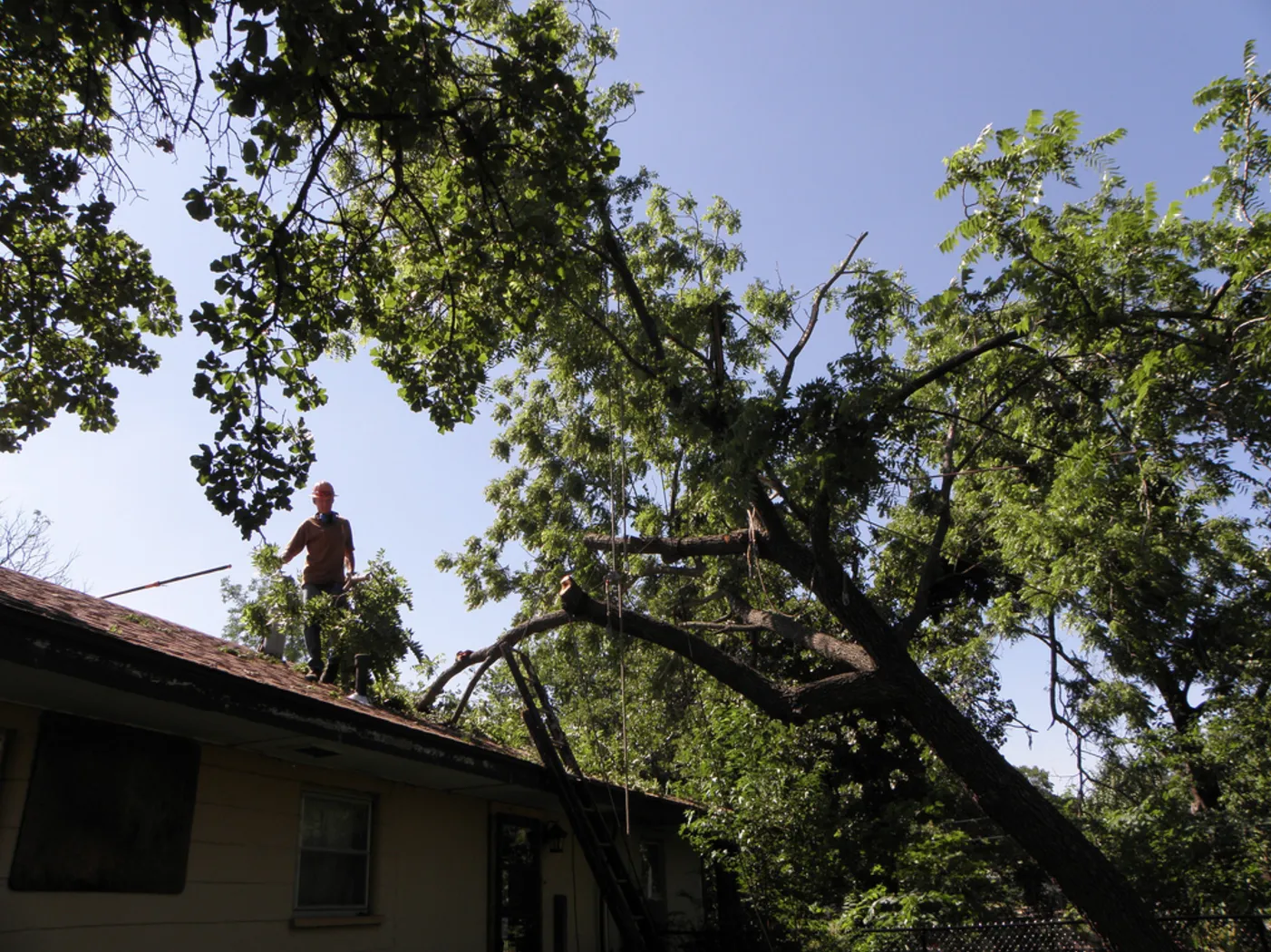
Emergency Storm Service in Mooresville
Mooresville sits in Indiana's tornado corridor with thousands of structurally weak silver maples. When storms hit, our ISA-certified crews respond in 40 minutes.
$20 OFF Your Service
Submit the form to claim your discount. Mention this offer when we call to confirm your estimate. Valid for all Mooresville properties.
The Fastest Way to Get Your Quote
Submit the form and we'll dispatch an estimator to your Mooresville property — that's our promise.
It's easier for everyone. We might be up in your neighbor's tree. The form gets us your info so we can schedule your estimate right away.
Prefer to call? We're here at (812) 432-2013
Get Your Quote in 24 Hours
Fill this out and we'll send an estimator to your Mooresville property.
Why Mooresville Is Vulnerable — Silver Maples, Shallow Roots, and Tornadoes
Mooresville sits along SR-67 in southern Morgan County, approximately 35 miles north of Bloomington. The town and its surrounding subdivisions occupy relatively flat terrain at the southern edge of the Indianapolis metropolitan area. This geography creates a storm vulnerability profile dominated by three factors: a weak tree species planted almost everywhere, shallow root systems in new developments, and a location squarely within central Indiana's tornado corridor.
Silver maples are the most common large tree in Mooresville's residential areas. Developers and homeowners planted them for decades because they grow fast and provide shade quickly. The problem is that silver maples are structurally the weakest of all commonly planted shade trees. Their wood is soft and brittle. Their branching pattern produces narrow crotch angles with included bark — a structural defect that creates a failure point. Their limbs grow long and heavy without adequate taper. During any storm producing winds above 50 mph, silver maples shed limbs like no other species. During stronger storms, they split apart at the trunk.
Mooresville's newer subdivisions — and there are many, as the town has grown rapidly — face the additional problem of shallow root establishment. Trees planted when a subdivision is developed typically have had three to eight years of root growth when the first serious storm tests them. That is not enough time for a root system to develop the lateral spread and depth needed to resist wind loading. These young trees either blow over entirely — root ball and all — or snap at the base where the trunk diameter has not yet developed storm-resistant dimensions.
The tornado threat is real. Mooresville is located in a corridor that stretches from southwestern Indiana through Morgan County and into the Indianapolis metropolitan area. This corridor produces tornado touchdowns multiple times per decade. The June 2023 tornado activity in central Indiana demonstrated what these storms can do to residential tree cover. Even EF0 and EF1 tornadoes — the weakest categories — produce winds sufficient to destroy silver maples and uproot shallow-planted subdivision trees.
Summer thunderstorms that do not reach tornado intensity still cause significant damage in Mooresville. Large, exposed trees in open subdivision landscapes catch wind without any buffering from adjacent forest. Unlike properties in wooded areas where surrounding trees absorb and redirect wind energy, Mooresville's subdivision trees stand alone in open yards, taking the full force of every gust.
Mooresville Emergency Response — What to Expect
Mooresville is the northernmost city in our service area, located approximately 35 miles from our Bloomington base via SR-37 and SR-67. Our standard response time is 40 minutes. For confirmed tornado events or major storm damage reports in the Mooresville area, we deploy crews immediately and drive directly without waiting for a specific property call, because we know from experience that Mooresville will generate multiple emergencies from any significant storm.
When you call our 24/7 live dispatcher, you speak to a real person who will gather the details of your emergency and deploy the nearest available crew. During multi-call events — which are common in Mooresville because storm damage tends to affect many properties simultaneously in subdivision settings — our dispatcher manages crew routing to minimize response time across all active emergencies.
Our Mooresville deployments are configured for the types of failures we see most often in this area. Silver maple branch failures and trunk splits require chainsaws and rigging equipment but rarely need crane support because the trees, while large, are not as massive as the sycamores and oaks we encounter in river corridor cities. This means our crew can work faster, moving from property to property efficiently during multi-site events.
For new subdivision properties where young trees have uprooted, removal is typically quicker but the root ball damage to lawns, irrigation systems, and underground utilities requires careful attention. We identify and flag any damaged utility lines or irrigation components during our removal process so you can arrange repair with the appropriate contractor.
We carry structural tarping materials on every Mooresville deployment. Silver maple failures frequently involve large limbs falling on roofs, and the irregular shape of silver maple branches means they punch through roofing material rather than sliding off. The jagged branch stubs create multiple puncture points that each need to be covered to prevent water intrusion during subsequent rainfall.
Our documentation process starts at arrival and continues through completion. Every Mooresville emergency generates a complete photographic record with timestamps, species identification, failure mechanism documentation, and removal process images. This package is built for insurance claim submission and has been accepted by every carrier we have encountered in Morgan County.
Storm Damage Patterns in Mooresville Subdivisions
Mooresville's emergency calls follow patterns driven by the prevalence of silver maples, the age of subdivision tree plantings, and the open exposure of residential lots.
Silver maple branch failures are the single most common emergency we respond to in Mooresville. These trees shed branches during thunderstorms with winds as low as 45 to 50 mph — a threshold that is exceeded by most summer storms strong enough to trigger a severe thunderstorm watch. The branches that fail are not small twigs. Silver maples produce long, heavy lateral branches with poor attachment strength. A single branch can be 20 feet long, eight inches in diameter at the base, and weigh several hundred pounds. When it falls on a roof, a vehicle, a fence, or a person, the damage is serious.
Trunk splits in silver maples are the second most common call. Multi-stemmed silver maples — trees with two or three main trunks joined at a single point — are everywhere in Mooresville. The junction between co-dominant stems often contains included bark, which is bark trapped inside the union rather than forming a strong interlocking grain pattern. Under storm loading, the included bark acts as a failure plane, and the stems peel apart. Half the tree falls in one direction, half in another. If the tree is near a house, both halves can damage different parts of the structure simultaneously.
Young tree uprooting in newer subdivisions follows a different pattern. These trees are typically five to fifteen years old, with trunk diameters of four to ten inches. They uproot completely during strong storms because their root systems have not yet established sufficient lateral spread. The damage from a single young tree uprooting is usually limited, but during a strong storm, multiple trees across a subdivision can uproot simultaneously. The cumulative damage — to roofs, vehicles, fences, and landscaping — adds up quickly.
Trees falling across power lines in Mooresville subdivisions can affect dozens of homes simultaneously because overhead distribution lines serve the entire neighborhood from a single corridor. A large silver maple falling across the main distribution line can knock out power to an entire street or block. We coordinate with Duke Energy on every power-line-involved call to ensure de-energization before our crew begins work.
Post-tornado scenarios in Mooresville produce the most concentrated damage. A tornado touching down in a Mooresville subdivision can destroy every silver maple and uproot every young tree in its path across multiple lots within seconds. The debris field from a tornado in a subdivision is a mixture of tree material, fencing, roofing components, and personal property. Systematic clearance requires heavy equipment, multiple crew members, and careful hazard identification because hidden dangers — energized wires, gas leaks, unstable structures — can be buried in the debris.
Filing Insurance Claims After Mooresville Storm Damage
Mooresville storm damage claims frequently involve multiple trees on a single property, which creates specific documentation and filing considerations that homeowners should understand.
Most homeowner's insurance policies in Morgan County include a per-tree limit for removal costs and a separate aggregate limit for total tree-related damage. When a single storm damages multiple silver maples on your property — which is common in Mooresville — the way the claim is documented directly affects your reimbursement. Our documentation treats each tree as a separate incident within the same storm event, with individual photographs, species identification, failure description, and removal cost. This per-tree documentation ensures you receive the maximum coverage your policy allows.
For silver maple failures, our documentation specifically records the failure mechanism — branch failure versus trunk split versus uprooting. This matters because adjusters evaluate whether the failure was caused by the storm or by a pre-existing structural defect that the homeowner should have addressed. Silver maples inherently have weak branch attachments and included bark unions, but these are characteristics of the species, not evidence of neglect. Our documentation makes this distinction clearly, referencing the known structural characteristics of Acer saccharinum and establishing that the failure was storm-initiated.
When young trees in newer subdivisions uproot, the damage to underground irrigation systems and utility conduits can exceed the cost of the tree removal itself. We document any underground damage we discover during the removal process so you can include it in your claim. Irrigation line breaks, landscape lighting wire damage, and disturbed drainage tile are common secondary effects of root ball upheaval that are often overlooked in claims.
For tornado damage claims, the documentation requirements are more extensive. We photograph the directional pattern of tree failures across your property and the surrounding area to establish consistency with the tornado track. We document the extent of debris scatter, which can help establish the wind speed and duration your property experienced. And we provide detailed invoicing that separates emergency stabilization from tree removal from debris clearance from site restoration.
We work regularly with State Farm, Allstate, Indiana Farm Bureau, and Nationwide on Morgan County claims. Many Mooresville properties carry coverage through agents in Mooresville, Martinsville, and the southern Indianapolis suburbs. Our documentation standards meet or exceed what every one of these carriers requires.
Mooresville Storm Emergency — Call Our Live Dispatcher
Silver maples do not wait for convenient timing to fail. Tornadoes do not schedule appointments. When a storm hits Mooresville, it hits fast and it hits hard — and the damage is immediate.
Bloomington Tree Service Pros provides 24/7/365 emergency storm response to Mooresville and southern Morgan County. We are ISA-certified arborists with full general liability and workers' compensation insurance. We carry the saws, the rigging, the tarps, and the documentation expertise to handle any tree emergency in any Mooresville subdivision, commercial lot, or rural property.
Do not attempt to remove a split silver maple yourself. A trunk split under tension stores enormous energy, and the two halves can snap together or fall unpredictably when cuts release the stored force. Do not drive under a hung limb to get your car out of the garage. Do not climb on your roof to inspect tree damage.
Call (812) 432-2013. A live dispatcher answers immediately — day or night, weekday or holiday. Our crew will be on your Mooresville property within 40 minutes, ready to secure the situation, prevent further damage, and document everything your insurance company needs to process your claim.
Our Emergency Storm Service Service Includes
- 24/7/365 live dispatcher — real crew response, not a voicemail, for every emergency call
- Rapid response to all Monroe County communities including Bloomington, Ellettsville, and Stinesville
- Structural tarping of roof breaches to prevent water intrusion while repairs are arranged
- Complete documentation of all storm damage with timestamped photos for insurance claims
- Hazardous limb removal from structures using rigging systems that prevent secondary damage
- Driveway and road clearance for blocked access — priority response for medical necessity situations
- Coordination with Duke Energy and Indiana utility providers for tree-on-wire situations
- Insurance carrier communication and direct adjuster coordination upon request
Other Tree Services in Mooresville
Need Emergency Storm Service in Mooresville?
Fill out the form at the top of this page to claim your $20 discount and get a free on-site estimate from our ISA-certified team.